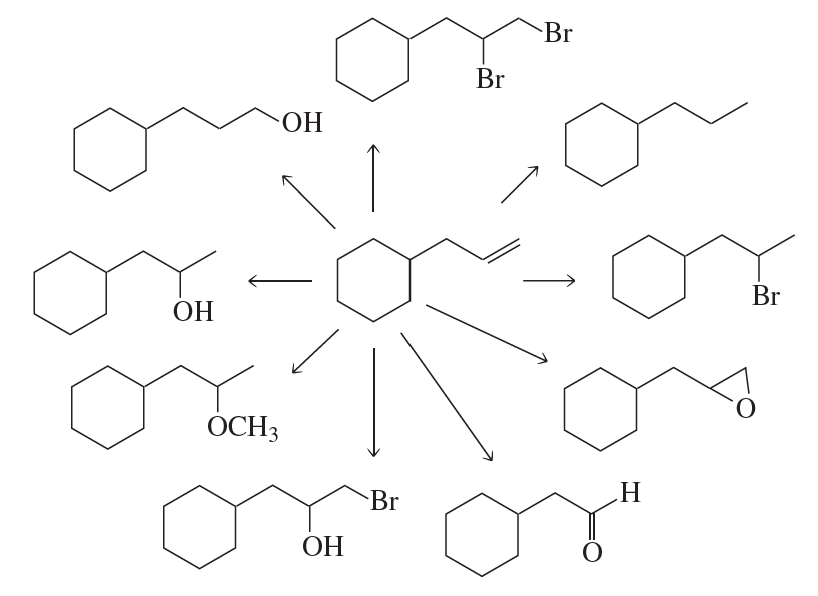
What reagents are needed to carry out the following syntheses?
Verified step by step guidance
1
Analyze the target molecule and the starting material to determine the functional groups present and the transformations required to convert the starting material into the target molecule.
Identify the key bond-forming steps or functional group interconversions needed. For example, if a carbon-carbon bond needs to be formed, consider reactions like aldol condensation, Grignard reactions, or Wittig reactions.
Determine the reagents required for each transformation. For instance, if an alcohol needs to be oxidized to a ketone, reagents like PCC (Pyridinium chlorochromate) or Jones reagent (CrO3/H2SO4) might be appropriate.
Consider the reaction conditions (e.g., temperature, solvent, and catalysts) that are compatible with the reagents and the functional groups in the molecule to avoid side reactions.
Verify the sequence of steps to ensure that each intermediate is stable and that the overall synthesis is efficient and feasible. Adjust the order of reactions if necessary to optimize the pathway.
Verified video answer for a similar problem:
This video solution was recommended by our tutors as helpful for the problem above
Video duration:
7m
Play a video:
0 Comments
Key Concepts
Here are the essential concepts you must grasp in order to answer the question correctly.
Reagents in Organic Synthesis
Reagents are substances or compounds that are added to a reaction to cause a chemical change. In organic synthesis, the choice of reagents is crucial as they determine the pathway and outcome of the reaction. Common reagents include acids, bases, oxidizing agents, and reducing agents, each playing specific roles in facilitating the transformation of reactants into desired products.
Synthesis of Amino Acids: Strecker Synthesis Example 1
Reaction Mechanisms
Understanding reaction mechanisms is essential for predicting the products of organic reactions. A reaction mechanism outlines the step-by-step process by which reactants are converted into products, including the formation and breaking of bonds. Familiarity with mechanisms helps in selecting appropriate reagents and conditions for a successful synthesis.
Functional groups are specific groups of atoms within molecules that are responsible for the characteristic chemical reactions of those molecules. Identifying functional groups in the starting materials and desired products is vital for determining the necessary reagents and reaction conditions. Knowledge of how different functional groups interact allows chemists to design effective synthetic routes.