Rank the ability of the following compounds to undergo an S_N1 reaction ( 1 = fastest, 5 = slowest ).
Verified step by step guidance
1
Step 1: Recall the key factors that influence the rate of an S_N1 reaction. The S_N1 mechanism involves the formation of a carbocation intermediate, so the stability of the carbocation is the most critical factor. More stable carbocations lead to faster S_N1 reactions.
Step 2: Analyze the structure of each compound provided in the problem. Identify the leaving group and the carbon atom to which it is attached. Consider the type of carbocation that would form if the leaving group departs (e.g., primary, secondary, tertiary, allylic, or benzylic).
Step 3: Rank the stability of the carbocations that would form. Tertiary carbocations are more stable than secondary carbocations, which are more stable than primary carbocations. Additionally, carbocations stabilized by resonance (e.g., allylic or benzylic) are more stable than those without resonance stabilization.
Step 4: Consider any additional factors that might influence the reaction rate, such as the quality of the leaving group (better leaving groups facilitate faster reactions) and the solvent (polar protic solvents stabilize the carbocation and favor S_N1 reactions).
Step 5: Based on the analysis of carbocation stability and other factors, rank the compounds from fastest to slowest in their ability to undergo an S_N1 reaction. Assign 1 to the compound with the fastest reaction rate and 5 to the compound with the slowest reaction rate.
Verified video answer for a similar problem:
This video solution was recommended by our tutors as helpful for the problem above
Video duration:
6m
Play a video:
0 Comments
Key Concepts
Here are the essential concepts you must grasp in order to answer the question correctly.
S_N1 Mechanism
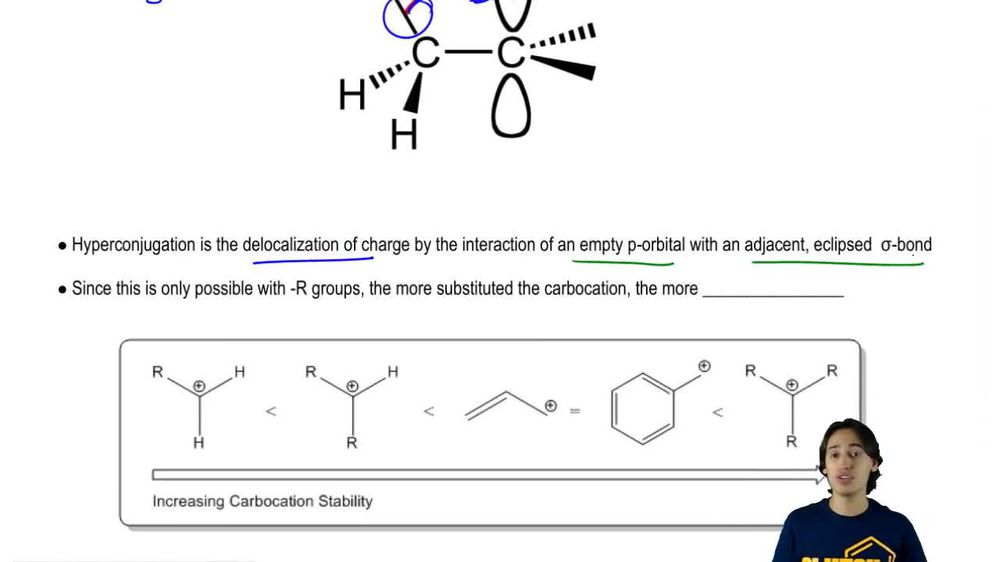
The S_N1 (substitution nucleophilic unimolecular) mechanism involves a two-step process where the rate-determining step is the formation of a carbocation intermediate. The reaction rate depends solely on the concentration of the substrate, not the nucleophile. This mechanism is favored by tertiary substrates due to their ability to stabilize the carbocation through hyperconjugation and inductive effects.
Carbocation stability is crucial in S_N1 reactions, as more stable carbocations form more readily and lead to faster reactions. Stability increases in the order of primary < secondary < tertiary, with resonance also playing a significant role. Compounds that can delocalize the positive charge through resonance structures will have enhanced stability and thus a higher likelihood of undergoing S_N1 reactions.
The choice of solvent significantly influences the rate of S_N1 reactions. Polar protic solvents stabilize the carbocation and the leaving group, facilitating the reaction. These solvents can also solvate the nucleophile, affecting its reactivity. Therefore, understanding solvent interactions is essential for predicting the reaction rate and ranking the compounds in an S_N1 context.

 6:32 minutes
 Verified step by step guidance
 04:32
04:32