Write structural formulas for the following compounds. (g) cis-2,3-epoxyhexane (h) (2R,3S)-2-methoxypentan-3-ol (i) trans-2,3-dimethyloxirane
Verified step by step guidance
1
Step 1: Understand the nomenclature for each compound. For example, 'cis' and 'trans' indicate the stereochemistry of the molecule, while prefixes like 'epoxy' and 'oxirane' refer to specific functional groups (epoxides). Additionally, the R/S configuration specifies the absolute stereochemistry of chiral centers.
Step 2: For (g) cis-2,3-epoxyhexane: Start by drawing a six-carbon chain (hexane). Identify the 2nd and 3rd carbons as the positions where the epoxide (a three-membered cyclic ether) is attached. Ensure the substituents on the 2nd and 3rd carbons are on the same side of the ring to represent the 'cis' configuration.
Step 3: For (h) (2R,3S)-2-methoxypentan-3-ol: Begin by drawing a five-carbon chain (pentane). Add a methoxy group (-OCH₃) to the 2nd carbon and a hydroxyl group (-OH) to the 3rd carbon. Assign the stereochemistry using the R/S system: (2R) means the substituents on the 2nd carbon are arranged in a clockwise priority order, and (3S) means the substituents on the 3rd carbon are arranged in a counterclockwise priority order.
Step 4: For (i) trans-2,3-dimethyloxirane: Draw the oxirane ring (a three-membered cyclic ether). Attach a methyl group (-CH₃) to both the 2nd and 3rd carbons of the ring. Ensure the methyl groups are on opposite sides of the ring to represent the 'trans' configuration.
Step 5: Verify the structures by checking the IUPAC naming rules and stereochemistry. Ensure that the functional groups, chain length, and stereochemical descriptors match the given names of the compounds.
Verified video answer for a similar problem:
This video solution was recommended by our tutors as helpful for the problem above
Video duration:
9m
Play a video:
0 Comments
Key Concepts
Here are the essential concepts you must grasp in order to answer the question correctly.
Stereochemistry
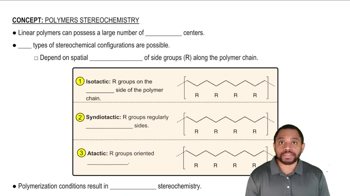
Stereochemistry is the study of the spatial arrangement of atoms in molecules and how this affects their chemical properties and reactions. It includes concepts such as chirality, which refers to molecules that cannot be superimposed on their mirror images, and geometric isomerism, which involves different spatial arrangements of substituents around a double bond or ring structure.
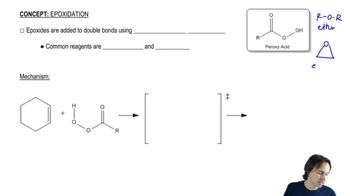
Epoxides are a class of cyclic ethers characterized by a three-membered ring containing an oxygen atom. They are highly reactive due to the strain in the ring, making them useful intermediates in organic synthesis. Understanding the formation and reactivity of epoxides is crucial for drawing structural formulas for compounds like cis-2,3-epoxyhexane and trans-2,3-dimethyloxirane.
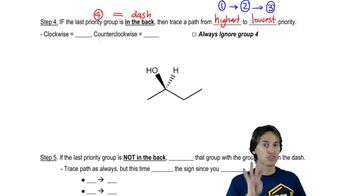
Chirality refers to the property of a molecule that has non-superimposable mirror images, often due to the presence of a chiral center, typically a carbon atom bonded to four different substituents. The R/S nomenclature system is used to assign configurations to these chiral centers, where 'R' indicates a clockwise arrangement and 'S' indicates a counterclockwise arrangement of the substituents when viewed from a specific perspective.