Draw the products of the following reactions: b. pentanoic acid + PBr3 + Br2, followed by hydrolysis
Verified step by step guidance
1
Step 1: Recognize the starting material, pentanoic acid, which is a carboxylic acid with five carbon atoms. The reaction involves PBr3 and Br2, followed by hydrolysis.
Step 2: Understand the role of PBr3 and Br2. PBr3 converts the carboxylic acid group (-COOH) into an acyl bromide (-COBr). This step activates the molecule for further reaction.
Step 3: The acyl bromide reacts with Br2 in the presence of PBr3, leading to alpha-bromination. This occurs at the alpha-carbon (the carbon adjacent to the carbonyl group) due to its increased reactivity.
Step 4: After alpha-bromination, hydrolysis (reaction with water) converts the acyl bromide back into a carboxylic acid. The bromine atom remains attached to the alpha-carbon.
Step 5: The final product is alpha-bromopentanoic acid, where the bromine atom is attached to the alpha-carbon of the pentanoic acid structure.
Verified video answer for a similar problem:
This video solution was recommended by our tutors as helpful for the problem above
Video duration:
2m
Play a video:
0 Comments
Key Concepts
Here are the essential concepts you must grasp in order to answer the question correctly.
Reactivity of Carboxylic Acids
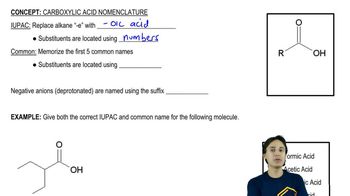
Carboxylic acids, like pentanoic acid, are organic compounds characterized by the presence of a carboxyl group (-COOH). They can undergo various reactions, including halogenation and conversion to acid halides. Understanding their reactivity is crucial for predicting the products when they react with reagents like PBr3 and Br2.
Phosphorus tribromide (PBr3) is commonly used to convert alcohols into alkyl bromides. In this reaction, PBr3 reacts with the hydroxyl group of pentanoic acid, facilitating the substitution of the -OH group with a bromine atom. This step is essential for the subsequent bromination of the resulting compound.
Synthesis of Amino Acids: Strecker Synthesis Example 1
Hydrolysis of Alkyl Halides
Hydrolysis is a reaction where water is used to break chemical bonds, often resulting in the formation of alcohols from alkyl halides. After the initial reaction with PBr3 and Br2, hydrolysis of the resulting alkyl bromide will yield a bromo-substituted carboxylic acid. This step is critical for determining the final products of the reaction sequence.