The formation of five-membered ring ethers is an important goal in synthetic organic chemistry because tetrahydrofurans are contained within a number of antitumor natural products. Toward that end, a one-pot synthesis of a bis-THF containing compound was developed (Eur. J. Org. Chem. 2010, 6263–6268). Suggest a mechanism for this transformation.
Verified step by step guidance
1
The reaction begins with the addition of mercuric acetate (Hg(OAc)2) to the alkene. This step forms a mercurinium ion intermediate, which is a cyclic structure where mercury is bonded to the two carbons of the former double bond.
The mercurinium ion is attacked by the hydroxyl group on the adjacent carbon, leading to the formation of the first tetrahydrofuran ring. This step involves the nucleophilic attack of the hydroxyl group on the more substituted carbon of the mercurinium ion, opening the ring and forming an ether linkage.
The second hydroxyl group then attacks the remaining mercurinium ion, forming the second tetrahydrofuran ring. This step is similar to the first ring formation, where the hydroxyl group acts as a nucleophile and attacks the more substituted carbon, resulting in the formation of the second ether linkage.
After the formation of both tetrahydrofuran rings, sodium borohydride (NaBH4) is used to reduce the mercury from the structure. This reduction step replaces the mercury with hydrogen, completing the transformation to the bis-THF compound.
Throughout the mechanism, stereochemistry is preserved due to the nature of the cyclic intermediates and the regioselectivity of the nucleophilic attacks. The final product retains the stereochemistry of the original hydroxyl groups, resulting in the specific orientation of the tetrahydrofuran rings.
Verified video answer for a similar problem:
This video solution was recommended by our tutors as helpful for the problem above
Video duration:
10m
Play a video:
0 Comments
Key Concepts
Here are the essential concepts you must grasp in order to answer the question correctly.
Five-Membered Ring Ethers
Five-membered ring ethers, such as tetrahydrofuran (THF), are cyclic compounds featuring an ether functional group. Their formation is significant in organic synthesis due to their presence in various biologically active molecules, including antitumor agents. Understanding the properties and reactivity of these compounds is essential for designing synthetic pathways that yield them efficiently.
One-pot synthesis refers to a method where multiple reaction steps are performed sequentially in a single reaction vessel without isolating intermediates. This approach enhances efficiency and reduces the time and resources needed for synthesis. In the context of forming bis-THF compounds, it allows for the simultaneous formation of multiple bonds and ring structures, streamlining the synthetic process.
Synthesis of Amino Acids: Strecker Synthesis Example 1
Reaction Mechanisms
A reaction mechanism is a detailed description of the step-by-step process by which reactants transform into products. It includes the identification of intermediates, transition states, and the types of chemical bonds formed or broken. Proposing a mechanism for the transformation in the question involves understanding the underlying chemistry, such as nucleophilic attacks and ring closures, which are critical for predicting the outcome of the synthesis.

 10:05 minutes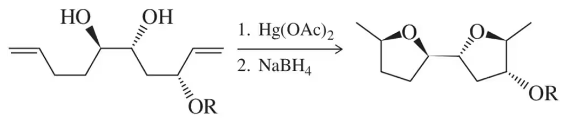
 Verified step by step guidance
 04:22
04:22