Textbook Question
Predict the product of the following benzylic bromination reactions.
(c)
907
views

 Mullins 1st EditionCh. 11 - Properties and Synthesis of Alkyl Halides: Radical ReactionsProblem 63a
 Verified step by step guidance
 00:54
00:54
 03:43
03:43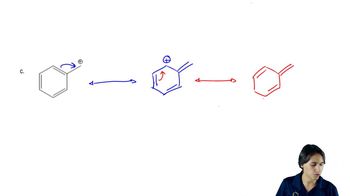 03:04
03:04Predict the product of the following benzylic bromination reactions.
(c)
Predict the product of the following benzylic bromination reactions.
(b)
A halogenation intended to make compound A formed B instead.
(c) Given the two mechanisms you drew, why might B have formed selectively?
The human body can excrete drugs and other exogenous molecules by converting them into polar, water-soluble compounds by a reaction similar to the autoxidation described in Section 11.6. Why are the following drug candidate molecules susceptible to oxidation by this pathway?
A halogenation intended to make compound A formed B instead.
(d) Without looking it up, would you expect C–Ha or C–Hb to have the lower bond-dissociation energy?
A halogenation intended to make compound A formed B instead.
(b) Suggest a mechanism that rationalizes the formation of B.