D-Xylose and D-lyxose are formed when d-threose undergoes a Kiliani–Fischer synthesis. D-Xylose is oxidized to an optically inactive aldaric acid, whereas D-lyxose forms an optically active aldaric acid. What are the structures of D-xylose and D-lyxose?
Verified step by step guidance
1
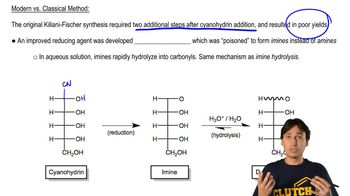
Understand the Kiliani–Fischer synthesis: This reaction lengthens the carbon chain of an aldose by one carbon atom, creating two new epimers (diastereomers) at the newly formed chiral center. Starting with d-threose, the reaction produces two pentoses: d-xylose and d-lyxose.
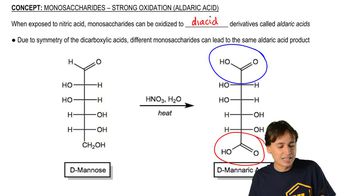
Analyze the oxidation to aldaric acids: Aldaric acids are formed by oxidizing both the aldehyde group (C1) and the terminal primary alcohol group (C5) of the sugar to carboxylic acids. The optical activity of the resulting aldaric acid depends on the symmetry of the molecule. If the aldaric acid is optically inactive, it must be symmetric.
Determine the structure of d-xylose: d-Xylose is oxidized to an optically inactive aldaric acid, indicating that the aldaric acid is symmetric. This symmetry arises because the hydroxyl groups on the chiral carbons (C2, C3, and C4) are arranged in such a way that the molecule is a meso compound. Draw the Fischer projection of d-xylose to confirm this symmetry.
Determine the structure of d-lyxose: d-Lyxose is oxidized to an optically active aldaric acid, meaning the aldaric acid is asymmetric. This asymmetry arises because the hydroxyl groups on the chiral carbons (C2, C3, and C4) are arranged in a way that the molecule lacks symmetry. Draw the Fischer projection of d-lyxose to confirm this asymmetry.
Compare the structures of d-xylose and d-lyxose: Both sugars are epimers at the C3 position. In d-xylose, the hydroxyl group at C3 is on the right in the Fischer projection, while in d-lyxose, it is on the left. Use this difference to distinguish between the two structures.
Verified video answer for a similar problem:
This video solution was recommended by our tutors as helpful for the problem above
Play a video:
0 Comments
Key Concepts
Here are the essential concepts you must grasp in order to answer the question correctly.
Kiliani–Fischer Synthesis
The Kiliani–Fischer synthesis is a method for elongating the carbon chain of aldoses, resulting in the formation of new aldoses. This reaction involves the addition of a cyanide ion to the carbonyl group of an aldose, followed by hydrolysis. It is particularly useful for synthesizing sugars with a higher number of carbon atoms from simpler sugars.
Aldaric acids are a type of dicarboxylic acid derived from aldoses, where both the aldehyde and the primary alcohol groups are oxidized to carboxylic acids. The optical activity of aldaric acids can vary depending on the structure of the parent aldose. Understanding the oxidation process is crucial for predicting the properties of the resulting aldaric acids.
Optical activity refers to the ability of a compound to rotate the plane of polarized light, which is a characteristic of chiral molecules. The presence of chiral centers in a molecule leads to different enantiomers, which can exhibit different optical activities. In the context of d-xylose and d-lyxose, the structural differences influence their optical properties and the nature of the aldaric acids they form.