Draw the Lewis structure for each of the following: f. NaOH
Verified step by step guidance
1
Step 1: Identify the elements in the compound NaOH. Sodium (Na) is a metal, oxygen (O) is a nonmetal, and hydrogen (H) is also a nonmetal. This compound is ionic in nature, with Na+ as the cation and OH⁻ as the anion.
Step 2: Begin by drawing the Lewis structure for the hydroxide ion (OH⁻). Oxygen has six valence electrons, and hydrogen has one valence electron. Since OH⁻ has a negative charge, add one extra electron to the oxygen atom, making a total of seven valence electrons for oxygen.
Step 3: Place the hydrogen atom bonded to the oxygen atom via a single covalent bond. Represent the bond as a line between the oxygen and hydrogen atoms. Distribute the remaining electrons around the oxygen atom to satisfy the octet rule. Oxygen will have three lone pairs of electrons.
Step 4: Represent the sodium ion (Na⁺) separately. Sodium loses one electron to form a positive charge, so it does not have any valence electrons in its Lewis structure. Write Na⁺ next to the hydroxide ion to indicate the ionic bond between Na⁺ and OH⁻.
Step 5: Combine the structures to show the complete Lewis structure of NaOH. The sodium ion (Na⁺) is adjacent to the hydroxide ion (OH⁻), with the ionic bond implied by their charges. Ensure the negative charge on OH⁻ and the positive charge on Na⁺ are clearly indicated.
Verified video answer for a similar problem:
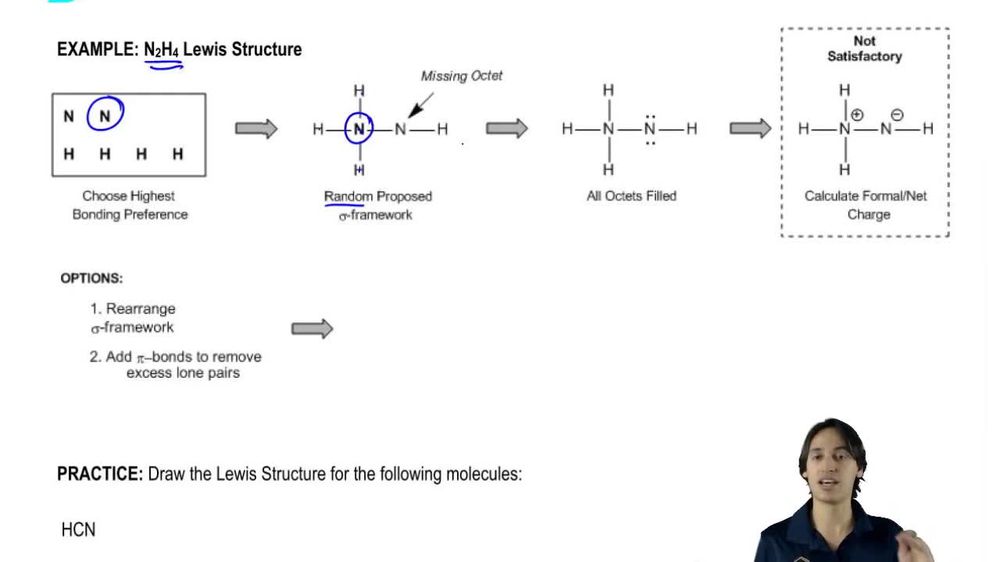
This video solution was recommended by our tutors as helpful for the problem above
Video duration:
3m
Play a video:
0 Comments
Key Concepts
Here are the essential concepts you must grasp in order to answer the question correctly.
Lewis Structures
Lewis structures are diagrams that represent the bonding between atoms in a molecule and the lone pairs of electrons that may exist. They use dots to represent valence electrons and lines to indicate bonds between atoms. Understanding how to draw Lewis structures is essential for visualizing molecular geometry and predicting reactivity.
Ionic compounds are formed when atoms transfer electrons, resulting in the formation of charged ions. In the case of NaOH, sodium (Na) donates an electron to become Na+, while hydroxide (OH-) is formed from oxygen and hydrogen. Recognizing the ionic nature of compounds helps in understanding their properties and behavior in chemical reactions.
Valence electrons are the outermost electrons of an atom and are crucial in determining how an atom bonds with others. The number of valence electrons influences the atom's reactivity and the type of bonds it can form. For NaOH, knowing the valence electrons of sodium, oxygen, and hydrogen is key to accurately drawing its Lewis structure.