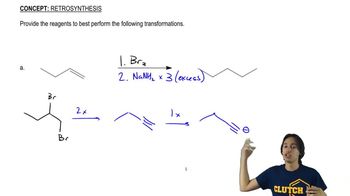
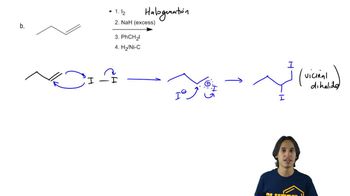
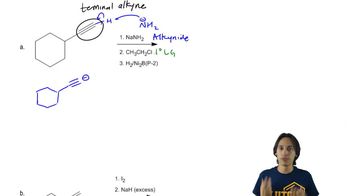
How can a terminal alkyne be used to synthesize a longer alkyne using an acetylide anion and an alkyl chloride? Describe the general reactants and the reaction mechanism involved.
A terminal alkyne can be deprotonated with a strong base such as NH2- to form an acetylide anion. This acetylide anion then acts as a nucleophile and undergoes an SN2 reaction with a primary alkyl chloride (or other primary alkyl halide), resulting in the formation of a new carbon-carbon bond and a longer alkyne. The general reactants are the terminal alkyne (to form the acetylide anion) and a primary alkyl chloride (as the electrophile).
 Back
Back

 03:25
03:25