Skip to main content
Organic Chemistry
My Course
Learn
Exam Prep
AI Tutor
Study Guides
Textbook Solutions
Flashcards
Explore
Try the app
My Course
Learn
Exam Prep
AI Tutor
Study Guides
Textbook Solutions
Flashcards
Explore
Try the app
Back
Aromaticity definitions
You can tap to flip the card.
Aromaticity
You can tap to flip the card.
👆
Aromaticity
A phenomenon conferring exceptional stability to certain unsaturated, cyclic compounds, making them unusually unreactive.
Track progress
Control buttons has been changed to "navigation" mode.
1/15
Related flashcards
Related practice
Recommended videos
Aromaticity quiz #1
Aromaticity
25 Terms
Aromaticity
18. Aromaticity
1 problem
Topic
Johnny
Huckel's Rule
18. Aromaticity
4 problems
Topic
Ernest
17. Aromaticity - Part 1 of 2
6 topics
13 problems
Chapter
Johnny
17. Aromaticity - Part 2 of 2
5 topics
12 problems
Chapter
Ernest
Guided course
08:19
Intro to Aromaticity
4017
views
81
rank
12
comments
Terms in this set (15)
Hide definitions
Aromaticity
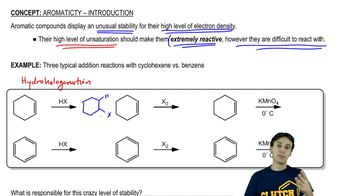
A phenomenon conferring exceptional stability to certain unsaturated, cyclic compounds, making them unusually unreactive.
Aromatic Compound
A molecule with high electron density and multiple double bonds in a ring, displaying remarkable chemical stability.
Benzene
A prototypical six-membered ring with alternating double bonds, known for its resistance to typical addition reactions.
Unsaturation
A structural feature involving double bonds or rings, resulting in fewer hydrogens than a fully saturated molecule.
Double Bond
A covalent connection involving two shared electron pairs, often found in unsaturated and aromatic systems.
Hydrohalogenation
A reaction where a hydrogen and a halogen are added across a double bond, typically not occurring with aromatic rings.
Halogenation
A process introducing halogen atoms to a molecule, which aromatic rings notably resist under standard conditions.
Non-aromatic Compound
A molecule lacking unusual stability or instability, behaving with typical reactivity seen in most organic compounds.
Anti-aromatic Compound
A highly unstable and reactive molecule with a cyclic, unsaturated structure, often decomposing rapidly.
Stability
A measure of a molecule's resistance to chemical change, exceptionally high in aromatic systems.
Reactivity
A tendency to undergo chemical reactions, which is unusually low in aromatic compounds and extremely high in anti-aromatic ones.
Ring
A closed loop of atoms, often containing double bonds, crucial for the unique properties of aromatic molecules.
Electron Density
A concentration of electrons within a molecule, especially high in aromatic systems due to delocalized pi bonds.
KMnO4
A strong oxidizing agent used in organic reactions, which aromatic rings resist under mild conditions.
Triene
A molecule containing three double bonds, which may be arranged in rings or chains, affecting its stability.
 BackBack

 08:19
08:19