Skip to main content
Organic Chemistry
My Course
Learn
Exam Prep
AI Tutor
Study Guides
Textbook Solutions
Flashcards
Explore
Try the app
My Course
Learn
Exam Prep
AI Tutor
Study Guides
Textbook Solutions
Flashcards
Explore
Try the app
Back
ATP and Energy definitions
You can tap to flip the card.
ATP
You can tap to flip the card.
👆
ATP
A high-energy molecule composed of adenosine and three phosphate groups, central to storing and transferring energy in cells.
Track progress
Control buttons has been changed to "navigation" mode.
1/13
Related flashcards
Recommended videos
ATP and Energy quiz #1
ATP and Energy
39 Terms
ATP and Energy quiz #2
ATP and Energy
40 Terms
ATP and Energy quiz #3
ATP and Energy
18 Terms
1:03
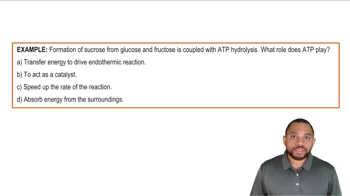
Adenosine Triphosphate Example 1
369
views
1:54
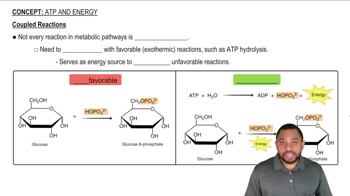
Coupled Reactions Concept 2
320
views
1:17
Coupled Reactions Example 2
345
views
1
rank
Terms in this set (13)
Hide definitions
ATP
A high-energy molecule composed of adenosine and three phosphate groups, central to storing and transferring energy in cells.
Adenosine
A molecular component consisting of a ribose sugar bonded to adenine, forming the backbone of ATP, ADP, and AMP.
Triphosphate
A chain of three phosphate groups linked together, whose bonds store significant chemical energy in ATP.
Phosphorus-Oxygen Bond
A chemical linkage within phosphate groups whose cleavage during hydrolysis releases substantial energy.
Hydrolysis
A reaction involving water that breaks chemical bonds, notably in ATP, resulting in energy release.
ADP
A molecule formed when ATP loses one phosphate group, containing two phosphates and capable of further energy release.
AMP
A molecule with a single phosphate group, produced from ADP hydrolysis, representing a lower-energy state.
Coupled Reaction
A process where an energy-releasing reaction, such as ATP hydrolysis, drives an otherwise unfavorable biochemical transformation.
Exothermic Reaction
A process that releases energy, often as heat, and can be harnessed to power other cellular reactions.
Glucose 6-Phosphate
A phosphorylated glucose molecule formed by attaching a phosphate group to the sixth carbon, crucial in metabolism.
Phosphate Group
A chemical group consisting of phosphorus and oxygen atoms, essential for energy transfer in biological molecules.
Catabolism
A metabolic pathway involving the breakdown of food molecules, providing energy stored in ATP.
Metabolic Pathway
A series of interconnected biochemical reactions within cells, often regulated by energy availability from ATP.
 BackBack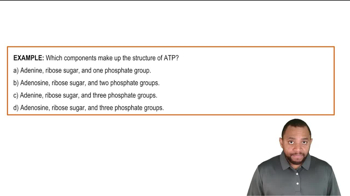
 1:03
1:03