How many calories per gram do carbohydrates provide?
Carbohydrates provide approximately 4 calories per gram.
What is the role of glucose in catabolite repression?
In catabolite repression, glucose acts as a preferred energy source, inhibiting the use of other carbon sources by repressing the expression of genes involved in their metabolism.
What is necessary for the complete breakdown of glucose?
Oxygen
What is the main purpose of glucose catabolism?
The main purpose of glucose catabolism is to convert glucose into pyruvate, producing ATP and NADH, which are used as energy sources for cellular processes.
All carbohydrates are broken down into what for energy?
All carbohydrates are broken down into glucose for energy.
When is carbon dioxide produced during glucose catabolism?
Carbon dioxide is produced during the citric acid cycle, which follows glycolysis in the complete aerobic breakdown of glucose.
How many calories per gram does carbohydrate contain?
Carbohydrates contain approximately 4 calories per gram.
Into which molecule are almost all molecules catabolized for energy converted?
Pyruvate
How many ATP molecules are used and produced per molecule of glucose during glycolysis?
During glycolysis, 2 ATP molecules are used and 4 ATP molecules are produced, resulting in a net gain of 2 ATP molecules per molecule of glucose.
C6H12O6 (glucose) + 6 O2 → 6 CO2 + 6 H2O: Where is most of the water in this reaction produced?
Most of the water in this reaction is produced during the electron transport chain, which is part of oxidative phosphorylation.
What are two true outcomes of glucose catabolism?
It produces ATP and NADH; It results in the formation of pyruvate
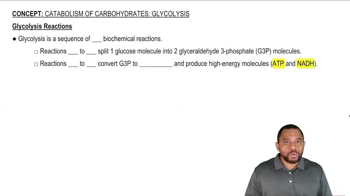
Which substance is broken down during the process of glycolysis?
Glucose is broken down during the process of glycolysis.
 Back
Back
 2:20
2:20