Skip to main content
Organic Chemistry
My Course
Learn
Exam Prep
AI Tutor
Study Guides
Textbook Solutions
Flashcards
Explore
Try the app
My Course
Learn
Exam Prep
AI Tutor
Study Guides
Textbook Solutions
Flashcards
Explore
Try the app
Back
Chirality definitions
You can tap to flip the card.
Chirality
You can tap to flip the card.
👆
Chirality
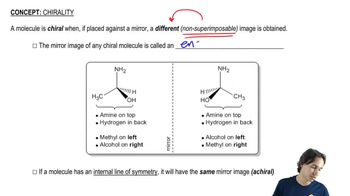
A property where an object and its mirror image are non-superimposable, leading to distinct spatial arrangements.
Track progress
Control buttons has been changed to "navigation" mode.
1/13
Related flashcards
Related practice
Recommended videos
Chirality quiz #1
Chirality
40 Terms
Chirality quiz #2
Chirality
40 Terms
Chirality quiz #3
Chirality
40 Terms
Atropisomers
5. Chirality
3 problems
Topic
Johnny
Test 1:Plane of Symmetry
5. Chirality
6 problems
Topic
Johnny
5. Chirality - Part 1 of 3
4 topics
15 problems
Chapter
Johnny
5. Chirality - Part 2 of 3
6 topics
15 problems
Chapter
Johnny
5. Chirality - Part 3 of 3
6 topics
15 problems
Chapter
Johnny
Guided course
03:24
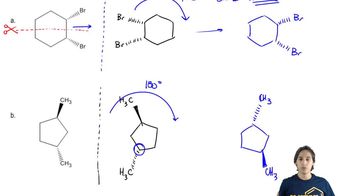
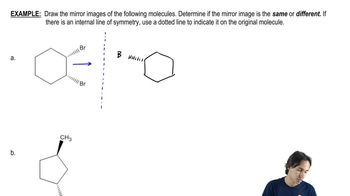
Drawing Mirror Images and Determining Chirality
5322
views
70
rank
12
comments
Guided course
05:10
What is chirality?
6007
views
68
rank
12
comments
Guided course
03:44
Drawing Mirror Images and Determining Chirality
5214
views
97
rank
18
comments
Terms in this set (13)
Hide definitions
Chirality
A property where an object and its mirror image are non-superimposable, leading to distinct spatial arrangements.
Mirror Image
A spatial reflection of an object, which may or may not be superimposable on the original.
Non-superimposable
Describes two objects that cannot be perfectly overlaid, even if rotated or flipped.
Chiral Compound
A molecule whose mirror image is different and cannot be aligned exactly with the original.
Achiral Compound
A molecule whose mirror image is identical and can be perfectly overlaid with the original.
Enantiomer
One of a pair of molecules that are non-superimposable mirror images of each other.
Line of Symmetry
An imaginary plane dividing an object into two identical halves, indicating potential achirality.
Wedge and Dash Notation
A drawing method showing three-dimensional arrangement, with wedges for front and dashes for back.
Methyl Group
A -CH3 substituent often used to illustrate positional changes in chiral molecules.
Amine Group
A -NH2 substituent, commonly referenced in examples of molecular chirality.
Hydroxyl Group
A -OH substituent, whose position helps determine if a molecule is chiral.
Stereoisomer
Molecules with the same formula and connectivity but different spatial arrangements.
Internal Symmetry
A feature where an object can be divided into two matching halves, often indicating achirality.
 BackBack
 03:24
03:24