What is a condensation reaction in organic chemistry, and how does it typically occur in enolate-mediated processes?
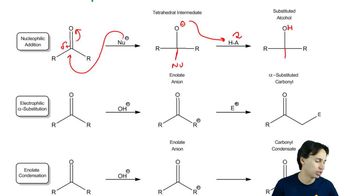
A condensation reaction in organic chemistry is a process where two molecules combine to form a larger molecule with the loss of a smaller molecule, such as water or alcohol. In enolate-mediated condensation reactions, an enolate ion (formed by deprotonation of an alpha carbon) reacts with another molecule, often a non-enolated version of itself, resulting in nucleophilic addition and the formation of a new carbon-carbon bond. Examples include the aldol reaction (between ketones or aldehydes) and the Claisen condensation (between esters).
 Back
Back

 05:53
05:53