Back

Dehydration Reaction quiz

Control buttons has been changed to "navigation" mode.
1/13
  • What role do electrons play in dehydration synthesis and hydrolysis?

    In dehydration synthesis, electrons are involved in forming new covalent bonds as water is removed, while in hydrolysis, electrons participate in breaking covalent bonds as water is added.
  • What is an example of a dehydration reaction?

    Formation of a peptide bond
  • What is an example of a dehydration reaction involving alcohol and alkene?

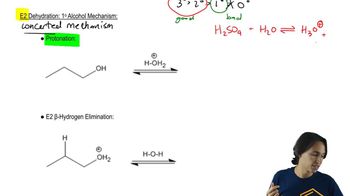
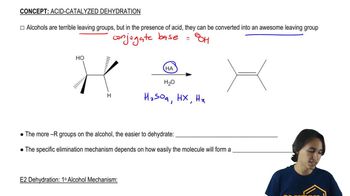
    Conversion of alcohol to alkene
  • What molecule is removed during dehydration synthesis?

    Water (H2O) is removed during dehydration synthesis.
  • What does dehydration synthesis involve?

    A reaction that removes water to form bonds
  • Which functional group may be used to form polymers via dehydration reactions?

    Hydroxyl groups
  • What compound is always formed as a result of dehydration synthesis?

    Water
  • What type of bond forms between two amino acids during a dehydration reaction?

    A peptide bond forms between two amino acids during a dehydration reaction.
  • What is an example of a dehydration synthesis reaction involving sugars?

    Formation of a disaccharide from monosaccharides
  • A dehydration synthesis reaction results in which two of the following? A) Formation of a new bond B) Release of water C) Absorption of water D) Breaking of a bond

    A) Formation of a new bond B) Release of water
  • What happens during dehydration synthesis?

    During dehydration synthesis, two molecules are joined together with the removal of a water molecule.
  • What does a dehydration synthesis reaction do to carbohydrates?

    A dehydration synthesis reaction links monosaccharides to form disaccharides or polysaccharides by removing water.
  • What occurs during dehydration synthesis?

    During dehydration synthesis, monomers are covalently bonded to form polymers, with the concurrent release of water molecules.