Skip to main content
Organic Chemistry
My Course
Learn
Exam Prep
AI Tutor
Study Guides
Textbook Solutions
Flashcards
Explore
Try the app
My Course
Learn
Exam Prep
AI Tutor
Study Guides
Textbook Solutions
Flashcards
Explore
Try the app
Back
Functional Groups quiz #2
You can tap to flip the card.
How is nitric oxide different from other signal molecules?
You can tap to flip the card.
👆
How is nitric oxide different from other signal molecules?
Nitric oxide is a gas that can diffuse across cell membranes, unlike most signal molecules that bind to receptors.
Track progress
Control buttons has been changed to "navigation" mode.
1/40
Related flashcards
Related practice
Recommended videos
Functional Groups quiz #1
Functional Groups
38 Terms
Functional Groups quiz #3
Functional Groups
39 Terms
Functional Groups quiz #4
Functional Groups
40 Terms
Functional Groups
2. Molecular Representations
6 problems
Topic
Johnny
How To Determine Solubility
2. Molecular Representations
7 problems
Topic
Johnny
2. Molecular Representations
3 topics
10 problems
Chapter
Ernest
Guided course
01:30
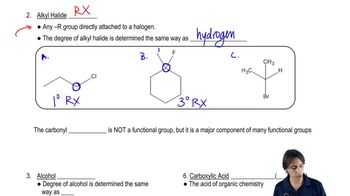
Assigning Degrees to Alkyl Halides
4365
views
43
rank
6
comments
Guided course
01:49
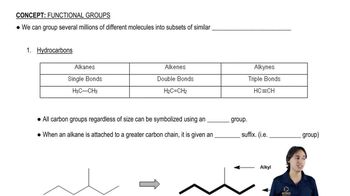
Why we need functional groups.
5969
views
80
rank
3
comments
Guided course
03:08
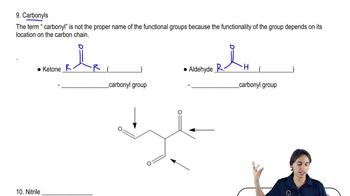
The difference between aldehydes and ketones.
4341
views
40
rank
9
comments
Terms in this set (40)
Hide definitions
How is nitric oxide different from other signal molecules?
Nitric oxide is a gas that can diffuse across cell membranes, unlike most signal molecules that bind to receptors.
Which biomolecule does not have a carbon-nitrogen bond? a) Protein b) Carbohydrate c) Nucleic acid d) Lipid
b) Carbohydrate
Which type of food best supports the growth of bacteria? a) High sugar b) High salt c) High fat d) High protein
a) High sugar
What are linked genes?
Linked genes are genes located close together on the same chromosome that tend to be inherited together.
Which category of nutrients protect the body from free radicals and the cellular damage they cause?
Antioxidants, such as vitamins C and E, protect the body from free radicals.
Which statement best describes why carbon can form a wide variety of organic compounds?
Carbon can form four covalent bonds, allowing it to build complex and diverse molecules.
Which of these is not a component of the lac operon? a) Promoter b) Operator c) Repressor d) Enhancer
d) Enhancer
What is the inducer molecule in the lac operon?
The inducer molecule in the lac operon is allolactose.
Why do fleshy fruits often have seeds with very tough seed coats?
Fleshy fruits have tough seed coats to protect the seeds during digestion and facilitate dispersal by animals.
What property of carbon makes it essential for organic life?
Carbon's ability to form four covalent bonds makes it essential for building complex organic molecules.
What is the primary component of bacterial cell walls?
Peptidoglycan
What component is found in gram-negative cells but not in gram-positive cells?
Lipopolysaccharide
What are the 4 types of ecosystem services?
The four types of ecosystem services are provisioning, regulating, cultural, and supporting services.
Which 2 macromolecules contain nitrogen?
Proteins and nucleic acids contain nitrogen.
What is a difference between yeast and mold?
Yeast is unicellular, while mold is multicellular.
What type of cell wall contains a thick layer of peptidoglycan and no outer membrane?
Gram-positive bacterial cell walls contain a thick layer of peptidoglycan and no outer membrane.
What are multiple alleles?
Multiple alleles refer to the presence of more than two alleles for a genetic trait within a population.
What is the role of pigments in the chloroplast?
They absorb light energy.
Which vitamins replaced vitamins A and C in the new food label daily values?
Vitamin D and potassium
What type of organisms take in atmospheric carbon dioxide?
Autotrophs, such as plants and some bacteria, take in atmospheric carbon dioxide for photosynthesis.
Which kingdom(s) include organisms that are autotrophic or heterotrophic?
The kingdom Protista includes organisms that can be autotrophic or heterotrophic.
What trait characterizes gymnosperms?
Seeds
Which property of carbon allows it to form complex organic molecules?
Carbon's ability to form four covalent bonds allows it to create complex organic molecules.
Which nutrients are classified as micronutrients?
Vitamins
What are the five basic tastes?
The five basic tastes are sweet, sour, salty, bitter, and umami.
Which vitamin is found only in animal-derived foods?
Vitamin B12 is found only in animal-derived foods.
What is the term to describe the mass of chewed food mixed with saliva?
The term is 'bolus.'
What is the photic zone?
The photic zone is the upper layer of a body of water where sunlight penetrates, allowing photosynthesis.
What is the name for the part of the enzyme where substrates and competitive inhibitors bind?
The active site is where substrates and competitive inhibitors bind.
What is true about functional groups in organic molecules?
They determine the properties of organic molecules.
Which plant hormone is responsible for phototropism?
Auxin is responsible for phototropism.
What type of genetic material do viruses contain?
They contain either DNA or RNA.
What are plants that initiate flowering as the nights extend longer than 12 hours?
These plants are called short-day plants.
Which kingdoms are prokaryotic?
The kingdoms Bacteria and Archaea are prokaryotic.
What is the most essential nutrient?
Water is the most essential nutrient.
How are gymnosperms classified?
Seed plants
Why is a carbonyl group polar?
A carbonyl group is polar because of the difference in electronegativity between carbon and oxygen, creating a dipole.
What is a hapten?
A hapten is a small molecule that, when combined with a larger carrier, can elicit an immune response.
What is an RF factor? How is this value used to identify unknown compounds?
An RF factor is the retention factor in chromatography, used to compare the movement of compounds on a stationary phase.
What is the function of the immersion oil?
Immersion oil is used in microscopy to increase the resolution by reducing light refraction.
 BackBack

 01:30
01:30