Skip to main content
Organic Chemistry
My Course
Learn
Exam Prep
AI Tutor
Study Guides
Textbook Solutions
Flashcards
Explore
Try the app
My Course
Learn
Exam Prep
AI Tutor
Study Guides
Textbook Solutions
Flashcards
Explore
Try the app
Back
Hydrolysis of Thioesters definitions
You can tap to flip the card.
Thioester
You can tap to flip the card.
👆
Thioester
A compound where sulfur replaces the oxygen in an ester, often undergoing hydrolysis to yield a carboxylic acid and a thiol.
Track progress
Control buttons has been changed to "navigation" mode.
1/14
Related flashcards
Recommended videos
Hydrolysis of Thioesters quiz
Hydrolysis of Thioesters
9 Terms
Hydrolysis of Thioesters quiz #1
Hydrolysis of Thioesters
10 Terms
1:00
Hydrolysis of Thioesters Concept 2
343
views
2
rank
3:09
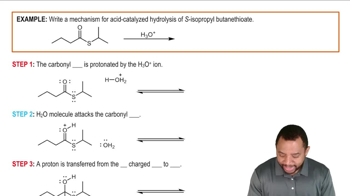
Hydrolysis of Thioesters Example 2
318
views
2
rank
3:33
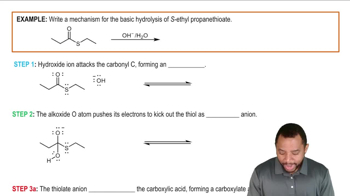
Hydrolysis of Thioesters Example 1
414
views
2
rank
Terms in this set (14)
Hide definitions
Thioester
A compound where sulfur replaces the oxygen in an ester, often undergoing hydrolysis to yield a carboxylic acid and a thiol.
Hydrolysis
A reaction involving water that cleaves a bond, commonly converting thioesters into carboxylic acids and thiols.
Carboxylic Acid
A product of thioester hydrolysis under acidic conditions, featuring a carbonyl and hydroxyl group.
Thiol
A sulfur-containing compound produced alongside carboxylic acid or carboxylate anion during thioester hydrolysis.
Nucleophilic Acyl Substitution
A mechanism where a nucleophile replaces a leaving group on a carbonyl carbon, central to thioester hydrolysis.
Protonation
The addition of a proton to a molecule, often initiating acid-catalyzed hydrolysis mechanisms.
Nucleophilic Attack
A step where an electron-rich species targets an electrophilic carbon, starting the breakdown of thioesters.
Proton Transfer
The movement of a proton between atoms or molecules, facilitating several steps in hydrolysis mechanisms.
Leaving Group
An atom or group that departs with an electron pair during a substitution, enabling bond cleavage in thioester hydrolysis.
Deprotonation
The removal of a proton from a molecule, often finalizing the formation of carboxylate anion in basic hydrolysis.
Saponification
A base-promoted hydrolysis of thioesters yielding a carboxylate anion and a thiol, distinct from acid-catalyzed pathways.
Carboxylate Anion
A negatively charged species formed when a carboxylic acid loses a proton under basic conditions.
Acid Catalysis
A process where an acid accelerates hydrolysis by donating protons, enabling key steps in the mechanism.
Base Hydrolysis
A reaction in basic medium where thioesters are converted to carboxylate anions and thiols via saponification.
 BackBack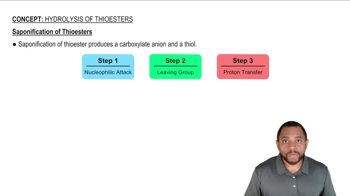
 1:00
1:00