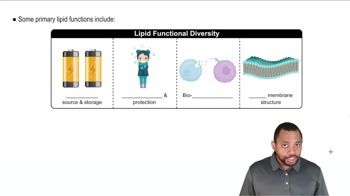
Hydrocarbon-based biomolecule that is hydrophobic, structurally diverse, and essential for energy storage, insulation, signaling, and membrane structure.
Fatty Acid
Long, unbranched hydrocarbon chain with a terminal carboxylic acid group, serving as a key component in many lipid types.
Hydrolyzable Lipid
Class of molecules that can be broken down by water to yield smaller units, often containing fatty acids.
Non-hydrolyzable Lipid
Structurally complex molecules that cannot be broken down by water and include steroids, terpenes, and eicosanoids.
Wax
Ester formed from an alcohol and a fatty acid, typically serving protective and structural roles in organisms.
Glycerolipid
Molecule composed of glycerol linked to fatty acids, forming the basis for energy storage fats and membrane components.
Triacylglycerol
Glycerol molecule bonded to three fatty acids, functioning as a primary energy storage form in cells.
Phospholipid
Major membrane component built from glycerol or sphingosine, containing fatty acids, a phosphate group, and often an amino alcohol.
Sphingolipid
Lipid containing a sphingosine backbone, often involved in membrane structure and signaling.
Steroid
Non-hydrolyzable molecule with a characteristic fused ring structure, involved in signaling and membrane fluidity.
Terpene
Non-hydrolyzable hydrocarbon built from isoprene units, often serving as precursors to hormones and pigments.
Eicosanoid
Non-hydrolyzable signaling molecule derived from fatty acids, involved in inflammation and other cellular processes.
Phosphoglyceride
Phospholipid with a glycerol backbone, two fatty acids, and a phosphate group linked to an amino alcohol.
Sphingomyelin
Sphingolipid containing a phosphate group and amino alcohol, crucial for nerve cell membrane structure.
Cell Membrane
Biological barrier composed largely of lipids, regulating nutrient and ion passage and maintaining cellular integrity.
 Back
Back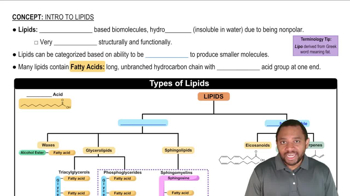
 3:13
3:13