Skip to main content
Organic Chemistry
My Course
Learn
Exam Prep
AI Tutor
Study Guides
Textbook Solutions
Flashcards
Explore
Try the app
My Course
Learn
Exam Prep
AI Tutor
Study Guides
Textbook Solutions
Flashcards
Explore
Try the app
Back
Intro to Metabolism definitions
You can tap to flip the card.
Metabolism
You can tap to flip the card.
👆
Metabolism
All biochemical reactions within an organism, encompassing both energy-releasing and energy-consuming processes.
Track progress
Control buttons has been changed to "navigation" mode.
1/15
Related flashcards
Recommended videos
Intro to Metabolism quiz #1
Intro to Metabolism
40 Terms
Intro to Metabolism quiz #2
Intro to Metabolism
1 Term
1:59
Stages of Catabolism Concept 2
222
views
1:37
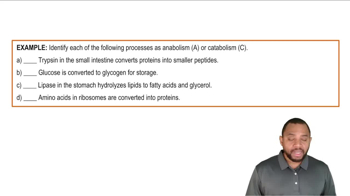
Intro to Metabolism Examples 1
257
views
1:03
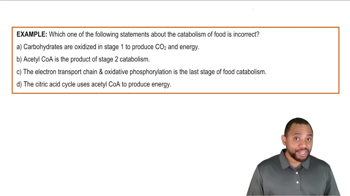
Stages of Catabolism Example 2
228
views
Terms in this set (15)
Hide definitions
Metabolism
All biochemical reactions within an organism, encompassing both energy-releasing and energy-consuming processes.
Catabolism
Pathway involving breakdown of larger molecules into smaller ones, resulting in energy release.
Anabolism
Pathway where smaller molecules are assembled into larger ones, requiring an input of energy.
Hydrolysis
Initial stage where macromolecules are split into smaller units like amino acids, glucose, and fatty acids.
Macromolecule
Large biological polymer such as proteins, carbohydrates, or lipids, serving as energy or structural sources.
Amino Acid
Building block produced from protein hydrolysis, essential for various metabolic pathways.
Glucose
Monosaccharide derived from carbohydrate hydrolysis, serving as a primary energy source.
Fatty Acid
Component released from lipid hydrolysis, later converted for energy production.
Acetyl CoA
Central metabolic intermediate formed after macromolecule breakdown, entering the Krebs Cycle.
Krebs Cycle
Cyclic pathway generating high-energy molecules and CO2 from Acetyl CoA in mitochondria.
NADH
High-energy electron carrier produced in the Krebs Cycle, crucial for ATP synthesis.
FADH2
Electron carrier generated during the Krebs Cycle, donating electrons to the electron transport chain.
ATP
Universal energy currency produced during catabolism, powering cellular activities.
Electron Transport Chain
Final catabolic stage where electrons from carriers generate ATP via oxidative phosphorylation.
Aerobic Respiration
Predominant energy-producing process in cells, requiring oxygen for efficient ATP generation.
 BackBack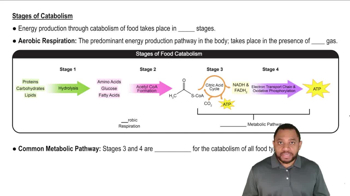
 1:59
1:59