Skip to main content
Organic Chemistry
My Course
Learn
Exam Prep
AI Tutor
Study Guides
Textbook Solutions
Flashcards
Explore
Try the app
My Course
Learn
Exam Prep
AI Tutor
Study Guides
Textbook Solutions
Flashcards
Explore
Try the app
Back
Introduction to Catalysis definitions
You can tap to flip the card.
Catalyst
You can tap to flip the card.
👆
Catalyst
A substance that increases reaction rate by lowering activation energy, remains unchanged after the reaction, and does not alter equilibrium.
Track progress
Control buttons has been changed to "navigation" mode.
1/13
Related flashcards
Recommended videos
Introduction to Catalysis quiz #1
Introduction to Catalysis
40 Terms
Introduction to Catalysis quiz #2
Introduction to Catalysis
40 Terms
Introduction to Catalysis quiz #3
Introduction to Catalysis
28 Terms
2:10
Introduction to Catalysis Concept 1
595
views
2
rank
1:22
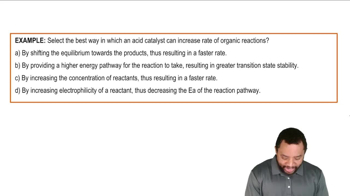
Introduction to Catalysis Example 1
569
views
Terms in this set (13)
Hide definitions
Catalyst
A substance that increases reaction rate by lowering activation energy, remains unchanged after the reaction, and does not alter equilibrium.
Activation Energy
The energy barrier that must be overcome for reactants to transform into products during a chemical reaction.
Equilibrium Constant
A value representing the ratio of product to reactant concentrations at equilibrium, unaffected by the presence of a catalyst.
Transition State
A high-energy, unstable arrangement of atoms that exists momentarily as reactants are converted to products.
Reaction Mechanism
A stepwise sequence of elementary reactions by which an overall chemical change occurs, possibly altered by catalysts.
Reactant Reactivity
The tendency of starting materials to participate in a chemical reaction, which can be enhanced by catalysts.
Electrophile
A species that accepts electron pairs during a reaction, with its reactivity often increased by catalytic action.
Nucleophile
A species that donates electron pairs to form new bonds, with its reactivity potentially enhanced by catalysts.
Leaving Group
An atom or group that departs with an electron pair during a reaction, with its ability improved by catalysts making it a weaker base.
Energy Profile
A graphical representation showing energy changes during a reaction, highlighting differences between catalyzed and uncatalyzed pathways.
Nucleophilic Acyl Substitution
A reaction where a nucleophile replaces a leaving group on an acyl compound, often facilitated by catalysts.
Electrophilic Addition
A reaction where an electrophile adds to a multiple bond, with catalysts often increasing the reaction rate.
Base Strength
A measure of a species' tendency to accept protons, with weaker bases serving as better leaving groups in catalyzed reactions.
 BackBack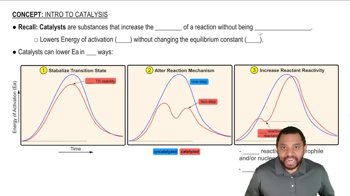
 2:10
2:10