Back

IUPAC Naming definitions

Control buttons has been changed to "navigation" mode.
1/14
  • IUPAC Nomenclature

    A systematic method established in 1919 for naming organic molecules to avoid confusion from inconsistent common names.
  • Alkane

    A saturated hydrocarbon containing only single bonds between carbon atoms, serving as the basis for basic naming rules.
  • Parent Chain

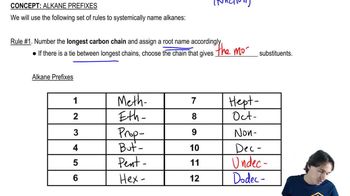
    The longest continuous chain of carbon atoms in a molecule, which determines the root name in systematic nomenclature.
  • Substituent

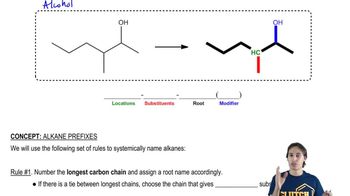
    A branch or group attached to the main carbon chain, requiring specific location numbers in the molecule's name.
  • Functional Group

    A specific group of atoms within a molecule that determines the molecule's suffix and chemical reactivity.
  • Prefix

    A modifier indicating the number of identical substituents, such as di-, tri-, or tetra-, used in systematic names.
  • Suffix

    The ending part of a molecule's name, determined by the main functional group, indicating the molecule's class.
  • Alkyl Group

    A group derived from an alkane by removing one hydrogen, named with a -yl ending, such as methyl or ethyl.
  • Locant

    A number assigned to a carbon atom in the parent chain to specify the position of a substituent or functional group.
  • Alphabetical Order

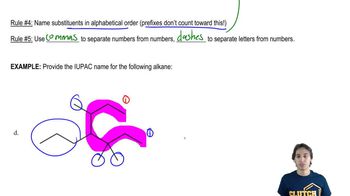
    The rule for listing substituents in a molecule's name, ignoring numerical prefixes, to ensure consistency.
  • Common Name

    A traditional, non-systematic name for a molecule, often based on arbitrary or historical references.
  • Hyphen

    A punctuation mark used to separate numbers from letters in systematic names, ensuring clarity in structure.
  • Comma

    A punctuation mark used to separate multiple numbers in a molecule's name, especially for locants.
  • Root Name

    The base part of a molecule's name, derived from the number of carbons in the parent chain, such as meth-, eth-, or prop-.