Back

Mass Spectrometry definitions

Control buttons has been changed to "navigation" mode.
1/15
  • Mass Spectrometry

    Analytical method that determines the molecular weight of a sample by analyzing ionized fragments based on their mass-to-charge ratio.
  • Electron Impact Ionization

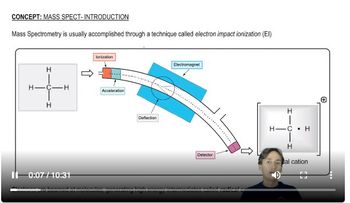
    Technique where high-energy electrons are used to knock electrons off molecules, creating charged species for analysis.
  • Radical Cation

    Species formed when a molecule loses one electron, resulting in both a positive charge and an unpaired electron.
  • Molecular Ion

    Ionized form of the original molecule with one electron removed, retaining nearly the same mass as the neutral molecule.
  • Parent Ion

    Primary ion generated from the sample, representing the intact molecule minus one electron; often used interchangeably with molecular ion.
  • Fragmentation

    Process where high-energy collisions break molecules into smaller charged pieces, producing multiple peaks in the spectrum.
  • Cationic Fragment

    Positively charged piece resulting from the breakup of the original molecule during ionization.
  • Mass-to-Charge Ratio

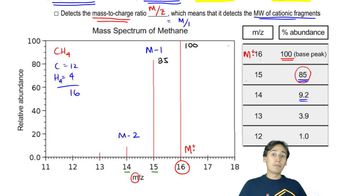
    Value (m/z) used to distinguish ions in a mass spectrometer, typically reflecting the mass of singly charged species.
  • Base Peak

    Tallest peak in a mass spectrum, set to 100% relative abundance, serving as a reference for comparing other peaks.
  • Relative Abundance

    Measurement of how frequently a particular ion appears in the spectrum, expressed as a percentage of the base peak.
  • Deflection

    Bending of ion paths in a magnetic field, with smaller ions being more easily redirected due to lower inertia.
  • Detection

    Stage where the instrument records the arrival of ions after separation, allowing for the construction of the mass spectrum.
  • Isotope

    Variant of an element differing in neutron number, sometimes causing additional peaks in the mass spectrum.
  • Ionization Phase

    Initial step where the sample is vaporized and bombarded with electrons to generate charged species for analysis.
  • Magnetic Field

    Component of the instrument that separates ions based on their mass-to-charge ratio by altering their trajectories.