What are the criteria for a compound to be classified as a meso compound in organic chemistry?
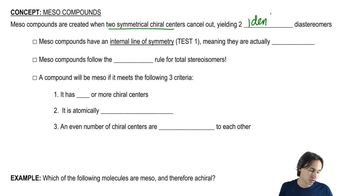
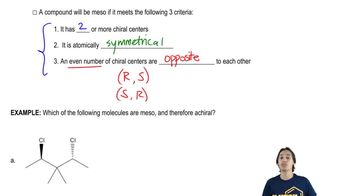
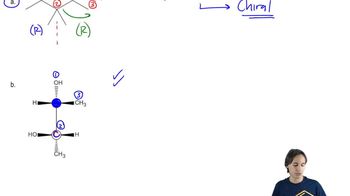
A compound is classified as a meso compound if it has two or more chiral centers, is atomically symmetrical, and has an even number of chiral centers with opposite configurations (such as R and S), resulting in overall achirality due to internal symmetry.
How can you determine if a cyclic molecule is a meso compound?
To determine if a cyclic molecule is a meso compound, check if it has two or more chiral centers, an internal line of symmetry, and opposite configurations at the chiral centers (e.g., one R and one S). If these criteria are met, the molecule is meso and achiral.
Which types of compounds can have a meso stereoisomer?
Compounds with two or more chiral centers that are atomically symmetrical and have opposite configurations at the chiral centers can have a meso stereoisomer. This is common in certain ring structures and symmetrical acyclic molecules.
What is the difference in the calculation of total stereoisomers for meso compounds compared to other compounds with chiral centers?
For meso compounds, the total number of stereoisomers is calculated using 2^(n-1), where n is the number of chiral centers, because two of the stereoisomers are identical. For other compounds, the formula is 2^n.
What structural feature is essential for a compound to be meso?
An internal line of symmetry is essential for a compound to be meso, as it allows the chiral centers to cancel each other out and makes the molecule achiral.
Can a compound with only one chiral center be a meso compound?
No, a compound with only one chiral center cannot be a meso compound. Meso compounds require at least two chiral centers.
Why are meso compounds considered achiral despite having chiral centers?
Meso compounds are considered achiral because their chiral centers have opposite configurations and the molecule has internal symmetry, causing the effects of chirality to cancel out.
Why does the formula for calculating the total number of stereoisomers differ for meso compounds compared to other molecules with chiral centers?
The formula differs because meso compounds have two stereoisomers that are identical due to internal symmetry, reducing the total count. Therefore, the formula is 2^(n-1) instead of 2^n for n chiral centers.
What does 'atomically symmetrical' mean in the context of identifying meso compounds?
Atomically symmetrical means that the atoms are connected in the same way on both sides of the molecule, even if the wedges and dashes do not match. This symmetry is necessary for the chiral centers to cancel each other out.
Why is it generally easier to identify meso compounds in ring structures than in acyclic compounds?
It is easier in ring structures because the internal line of symmetry is more apparent, making the application of symmetry tests straightforward. In acyclic compounds, symmetry is less obvious, so other criteria must be used.