Back

Nucleophilic Substitution definitions

Control buttons has been changed to "navigation" mode.
1/15
  • Nucleophile

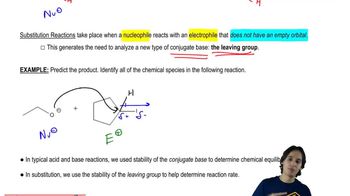
    Species with high electron density, often carrying a negative charge, that donates electrons to form new bonds.
  • Electrophile

    Species with low electron density, often neutral or electron-deficient, that accepts electrons during reactions.
  • Substitution Reaction

    Process where a nucleophile replaces a group attached to an electrophile, requiring bond breaking and forming.
  • Bronsted-Lowry Reaction

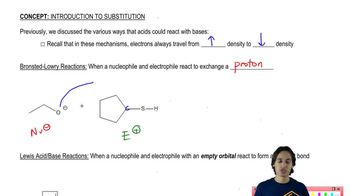
    Type of acid-base process involving proton transfer and formation of a conjugate base and new bond.
  • Lewis Acid

    Electron-deficient species, often with an empty orbital, that readily accepts electron pairs.
  • Lewis Base

    Electron-rich species capable of donating a pair of electrons to form a covalent bond.
  • Leaving Group

    Atom or group that departs with an electron pair when a new bond forms during substitution.
  • Conjugate Base

    Species formed after an acid donates a proton, often acting as a leaving group in reactions.
  • Formal Charge

    Calculated value indicating electron distribution on an atom, used to assess stability after reactions.
  • Octet

    Stable electron configuration where an atom possesses eight valence electrons, guiding bond formation.
  • Dipole

    Separation of charge within a bond, creating partial positive and negative regions that influence reactivity.
  • Acidic Hydrogen

    Hydrogen atom with partial positive character, easily transferred during acid-base or substitution reactions.
  • Sigma Bond

    Single covalent bond formed by direct overlap of orbitals, resulting from electron pair sharing.
  • Empty Orbital

    Unoccupied atomic or molecular region capable of accepting electron pairs during bond formation.
  • Equilibrium Arrow

    Symbol indicating reversible reactions, especially in proton transfer processes.