R and S Configuration quiz #1 Flashcards

R and S Configuration quiz #1
Control buttons has been changed to "navigation" mode.
1/10
  • How do you determine if a chiral center in a molecule has an S configuration using the R and S system?
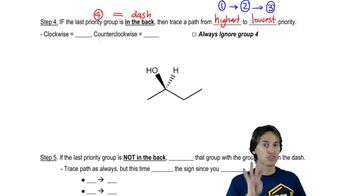
    To determine if a chiral center has an S configuration, assign priorities to the four groups attached to the chiral center based on atomic mass (highest = 1, lowest = 4). If the lowest priority group (4) is oriented in the back (on a dash), trace a path from priority 1 to 2 to 3. If this path is counterclockwise, the configuration is S. If the lowest priority group is not in the back, swap it with the group on the dash, trace the path, and then reverse the R/S designation.
  • What is the step-by-step process for assigning the R or S designation to a stereocenter carbon atom in a molecule?
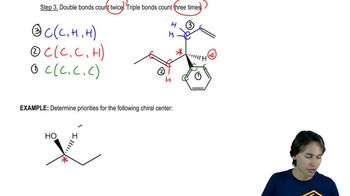
    First, identify the chiral center and assign priorities to the four attached groups based on atomic mass. If there is a tie, compare the next set of atoms (playoff system). For double or triple bonds, count them as multiple connections. Orient the molecule so the lowest priority group (4) is in the back; trace a path from 1 to 2 to 3. If the path is clockwise, assign R; if counterclockwise, assign S. If the lowest priority group is not in the back, swap it with the group on the dash, trace the path, and reverse the R/S designation.
  • What is the purpose of the Cahn-Ingold-Prelog nomenclature in organic chemistry?
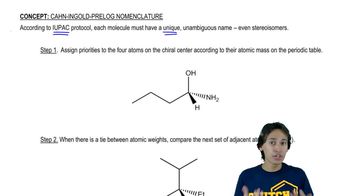
    The Cahn-Ingold-Prelog nomenclature is used to assign unique names to stereoisomers by specifying the configuration of chiral centers. It ensures that each molecule, including those with chiral centers, has a distinct IUPAC name.
  • How do you resolve a tie when two atoms attached to a chiral center have the same atomic mass?
    You use the playoff system, comparing the next set of atoms attached to each tied atom based on their atomic masses. The atom with the heavier attached group wins the higher priority.
  • What is the 'big seven' and how is it used in assigning priorities to groups on a chiral center?
    The 'big seven' is a mnemonic for remembering the order of common atoms by atomic mass: C, N, O, F, Cl, Br, I. It helps quickly assign priorities when determining R or S configuration.
  • How are double and triple bonds treated when assigning priorities in the playoff system?
    Double bonds are counted as two connections and triple bonds as three connections to the same atom. This approach ensures all bonding interactions are considered in priority assignment.
  • What should you do if the lowest priority group is not on the dash in a 3D structure?
    You swap the lowest priority group with the group on the dash, assign the configuration as usual, and then reverse the R/S designation. This compensates for the initial swap in orientation.
  • Why is hydrogen almost always assigned the lowest priority when determining R or S configuration?
    Hydrogen has the lowest atomic mass of all atoms commonly found in organic molecules. Therefore, it is always assigned priority number 4 in the Cahn-Ingold-Prelog system.
  • When tracing the path from priority 1 to 2 to 3, why is group 4 ignored?
    Group 4 is ignored because it is positioned in the back (on the dash) and does not affect the direction of the path traced for R or S assignment. Only the arrangement of groups 1, 2, and 3 determines the configuration.
  • What is the significance of clockwise versus counterclockwise tracing in R and S configuration assignment?
    A clockwise path from priority 1 to 2 to 3 indicates an R configuration, while a counterclockwise path indicates an S configuration. This distinction is the basis for the R and S naming system.