Back

What is the Relationship Between Isomers? definitions

Control buttons has been changed to "navigation" mode.
1/15
  • Isomer

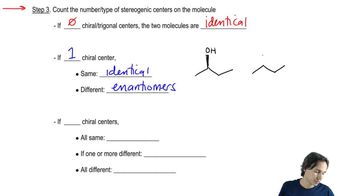
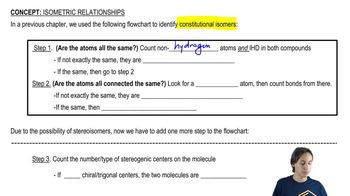
    A compound sharing the same molecular formula as another but differing in atom connectivity or spatial arrangement.
  • Constitutional Isomer

    A molecule with the same atom count as another but differing in how those atoms are connected.
  • Stereoisomer

    A compound with the same atom connectivity as another but differing in the three-dimensional arrangement of atoms.
  • Chiral Center

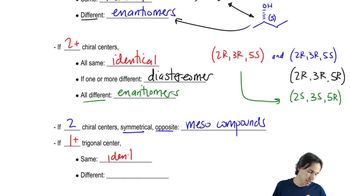
    A carbon atom bonded to four distinct groups, leading to non-superimposable mirror images.
  • Enantiomer

    A non-superimposable mirror image of a molecule, differing at all chiral centers.
  • Diastereomer

    A stereoisomer that is not a mirror image, differing at some but not all chiral centers.
  • Meso Compound

    A molecule with multiple chiral centers that is overall achiral due to internal symmetry.
  • Trigonal Center

    A double-bonded carbon with groups arranged in a planar geometry, allowing for cis/trans isomerism.
  • Cis Isomer

    A molecule with similar groups on the same side of a double bond or ring, affecting physical properties.
  • Trans Isomer

    A molecule with similar groups on opposite sides of a double bond or ring, leading to distinct spatial arrangement.
  • R Configuration

    A spatial arrangement at a chiral center where priority groups decrease in a clockwise direction.
  • S Configuration

    A spatial arrangement at a chiral center where priority groups decrease in a counterclockwise direction.
  • Molecular Formula

    A notation indicating the number and type of atoms present in a molecule.
  • Connectivity

    The specific sequence in which atoms are bonded within a molecule.
  • Mirror Image

    A spatial reflection of a molecule that may or may not be superimposable, crucial for distinguishing enantiomers.