How does the Wittig reaction allow for the regiospecific synthesis of alkenes from aldehydes or ketones, and what is the general process for predicting the alkene product formed?
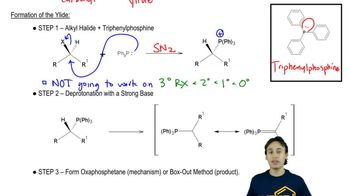
The Wittig reaction enables the regiospecific synthesis of alkenes by reacting an aldehyde or ketone with a phosphorus ylide. This reaction forms a new carbon-carbon double bond, allowing precise control over the placement of R groups on the resulting alkene. To predict the alkene product, align the phosphorus atom of the ylide with the oxygen atom of the carbonyl compound, visualize the new double bond forming between the ylide carbon and the carbonyl carbon, and combine the R groups from both reactants across the double bond. The reaction is not stereospecific, so both E and Z isomers may form if possible.
 Back
Back

 15:39
15:39