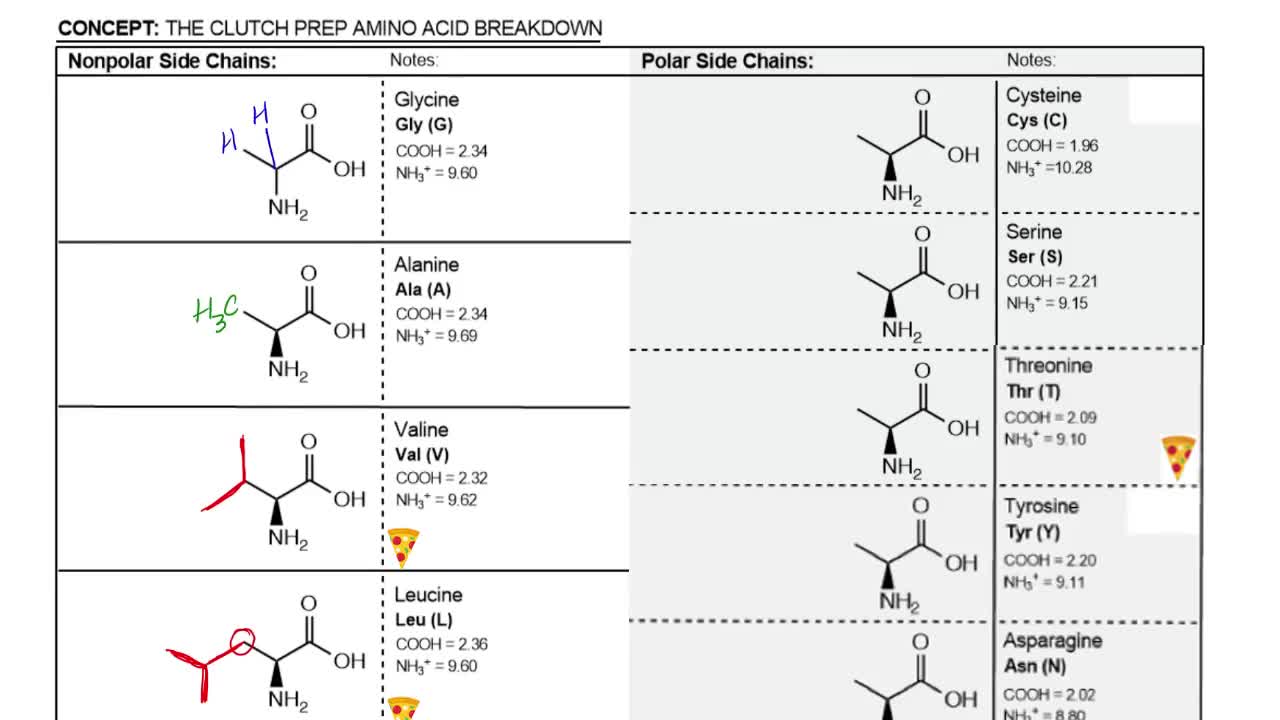
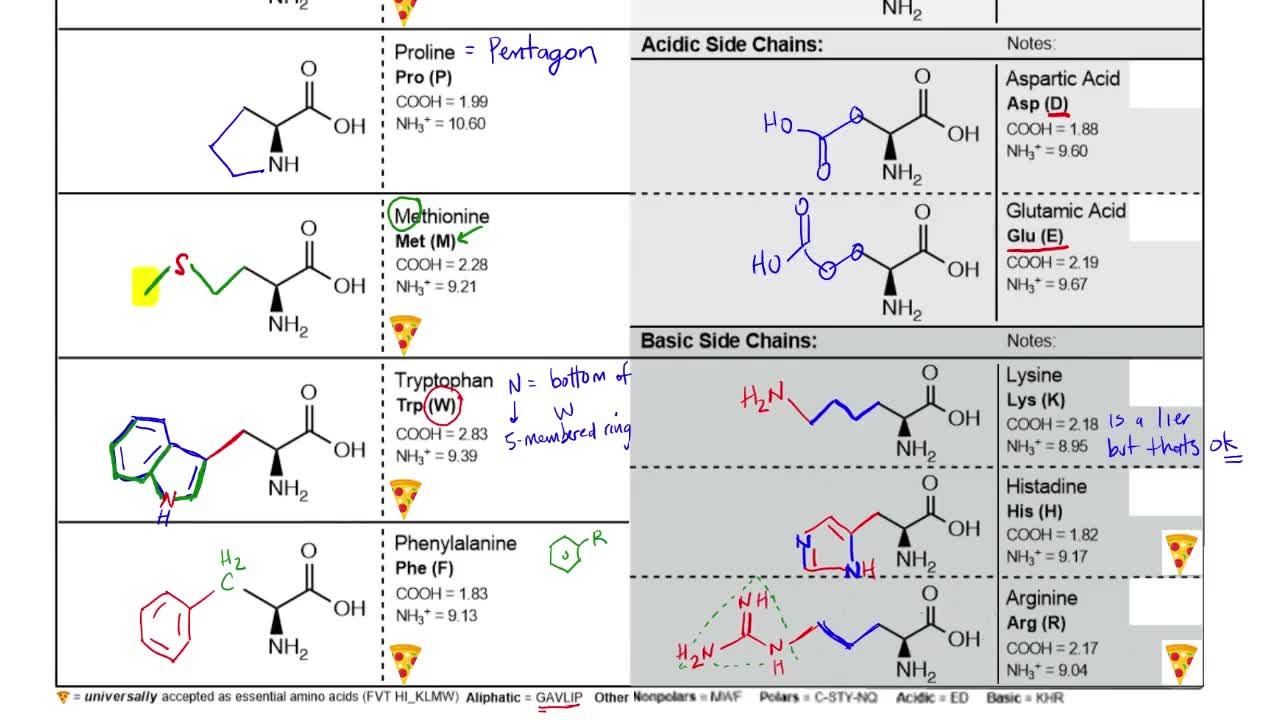
An amino acid has an amino group attached to the α-carbon of a carboxylic acid, with a variable side chain (R group).
How many naturally occurring amino acids are there and how are they classified?
There are 20 naturally occurring amino acids, classified as L-configuration at the stereocenter (except glycine).
What are the three main classes of amino acid side chains?
Side chains are classified as Neutral (nonpolar), Acidic (carboxyl groups), or Basic (amine groups).
What is the isoelectric point (pI) of an amino acid?
The pI is the pH at which the amino acid has no net charge, calculated as the average of the pKa values of its ionizable groups.
How does the charge of an amino acid change with pH?
At low pH, amino acids are protonated and positively charged; at high pH, they are deprotonated and negatively charged.
What is the principle behind separating amino acids using acid-base chemistry?
Amino acids can be separated by their charge differences at various pH values using electrophoresis or chromatography.
What is the Hell-Volhard-Zelinsky reaction used for in amino acid synthesis?
It is used to prepare α-bromo carboxylic acids, which are intermediates in amino acid synthesis.
What is the role of phthalimide in amino acid synthesis?
Phthalimide acts as a nitrogen source and protects the amine group during synthesis, later hydrolyzed to release the amino acid.
What is the Strecker synthesis?
A method to synthesize amino acids by reacting an aldehyde with ammonia and cyanide to form an α-aminonitrile, then hydrolyzed to an amino acid.
How are amino acids joined to form peptides?
Amino acids are joined by peptide (amide) bonds formed between the carboxyl group of one amino acid and the amino group of another.
In which direction is a polypeptide sequence written?
Polypeptide sequences are written from the amino (N) terminus to the carboxyl (C) terminus.
What is the difference between primary and secondary protein structure?
Primary structure is the amino acid sequence; secondary structure refers to local folding patterns like α-helices and β-sheets stabilized by hydrogen bonds.
What stabilizes the α-helix and β-sheet structures in proteins?
Intramolecular hydrogen bonds between amide groups stabilize these secondary structures.
Why is rotation about the amide bond in peptides restricted?
Because the amide bond has partial double bond character (~40%), restricting rotation and stabilizing the planar structure.
What is the significance of the trans and cis conformations in peptide bonds?
The trans conformation is generally preferred due to less steric hindrance, except for proline which can favor cis.
What is the tertiary structure of a protein?
The tertiary structure is the 3D arrangement of secondary structural elements and side chains, stabilized by hydrophobic interactions, hydrogen bonds, ionic bonds, and disulfide bridges.
What is the quaternary structure of a protein?
The quaternary structure is the assembly of multiple polypeptide chains into a functional protein complex.
How are peptide bonds chemically synthesized in the lab?
By activating the carboxyl group of one amino acid (e.g., as an acyl chloride or mixed anhydride) and coupling it with the amino group of another, often using protecting groups.
What is the purpose of protecting groups like Cbz in peptide synthesis?
Protecting groups prevent unwanted reactions at the amino group during peptide bond formation.
How does Edman degradation determine amino acid sequence?
It sequentially removes and identifies the N-terminal amino acid from a peptide, allowing determination of the sequence up to ~50-60 residues.
What enzymes are used to cleave polypeptides for sequencing?
Trypsin cleaves at the carboxyl side of Lys and Arg; chymotrypsin cleaves at the carboxyl side of aromatic amino acids Phe, Tyr, and Trp.
 Back
Back
 15:55
15:55