Back

IR Stretching Frequencies of Functional Groups

Control buttons has been changed to "navigation" mode.
1/17
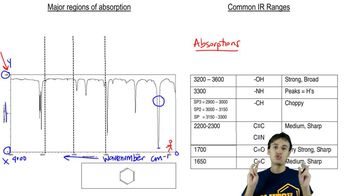
  • IR stretching frequency for alcohol O-H

    3300 cm-1, always broad

  • IR stretching frequency for amine or amide N-H

    3300 cm-1, may be broad, sharp, or broad with spikes

  • IR stretching frequency for alkyne C-H

    3300 cm-1, always sharp, usually strong

  • IR stretching frequency for alkane C-H

    Just below 3000 cm-1

  • IR stretching frequency for alkene C-H

    Just above 3000 cm-1

  • IR stretching frequency for acid O-H

    Very broad absorption around 3000 cm-1

  • IR stretching frequency for alkyne C≡C

    Just below 2200 cm-1

  • IR stretching frequency for nitrile C≡N

    Just above 2200 cm-1

  • IR stretching frequency for carbonyl C=O in ketones and acids

    About 1710 cm-1, very strong

  • IR stretching frequency for carbonyl C=O in aldehydes

    About 1725 cm-1

  • IR stretching frequency for carbonyl C=O in esters

    Higher than ketones, about 1735 cm-1

  • IR stretching frequency for carbonyl C=O in amides

    Lower than ketones, about 1650 cm-1

  • Effect of conjugation on carbonyl frequency

    Conjugation lowers the carbonyl stretching frequency

  • IR stretching frequency for alkene C=C

    About 1660 cm-1, conjugation lowers frequency

  • IR stretching frequency for aromatic C=C

    About 1600 cm-1

  • IR stretching frequency for imine C=N

    Stronger than C=C, about 1660 cm-1

  • IR stretching frequency for amide C=O

    Stronger than C=C, about 1660 cm-1