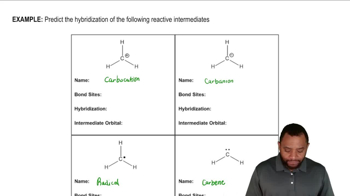
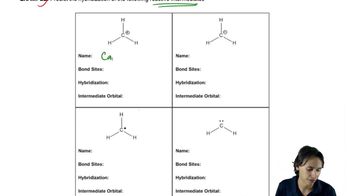
What is the hybridization of carbon atoms in alkenes?
Carbons in alkenes are sp2 hybridized, forming sigma bonds with overlap of sp2 orbitals and a pi bond from unhybridized p orbitals.
What is an element of unsaturation in hydrocarbons?
An element of unsaturation is a structural feature like a pi bond or ring that reduces the number of hydrogens by two compared to a saturated alkane.
How do you calculate the number of elements of unsaturation?
Elements of unsaturation = half the number of missing hydrogens compared to the saturated formula CnH2n+2.
How are halogens, oxygen, and nitrogen treated in calculating elements of unsaturation?
Halogens count as hydrogens, oxygen is ignored, and nitrogen counts as half a carbon atom in the calculation.
What is the IUPAC rule for numbering the parent chain in alkenes?
Number the longest chain containing the double bond to give the double bond the lowest possible number, with double bonds taking precedence over alkyl groups and halogens.
What is cis-trans isomerism in alkenes?
Cis-trans (geometric) isomerism arises when substituents on the double bond carbons differ, allowing distinct spatial arrangements (same side = cis, opposite side = trans).
What is the E-Z notation system for alkenes?
E-Z notation assigns configuration based on Cahn-Ingold-Prelog priority rules: Z if higher priority groups are on the same side, E if on opposite sides.
What factors govern the stability of alkenes?
Alkene stability increases with: 1) higher degree of substitution of the C=C, 2) less Van der Waals strain (trans more stable than cis), 3) more chain branching.
What is the relationship between heat of hydrogenation and alkene stability?
Lower heat of hydrogenation corresponds to greater alkene stability.
What is the difference between E1 and E2 elimination mechanisms?
E1 is unimolecular, two-step with carbocation intermediate and first-order kinetics; E2 is bimolecular, one-step with strong base and second-order kinetics.
What is dehydrohalogenation in alkyl halides?
Dehydrohalogenation is a β-elimination reaction where a hydrogen and halogen are removed, often using a strong base like sodium ethoxide.
What is Zaitsev's rule in elimination reactions?
The major alkene product is usually the one formed by removing a β-hydrogen from the carbon with the fewest hydrogens, leading to the most substituted alkene.
How do bulky bases affect elimination regioselectivity?
Bulky bases favor abstraction of less hindered β-hydrogens, often producing the less substituted Hofmann product instead of the Zaitsev product.
What is the stereochemical requirement for E2 elimination?
E2 elimination requires an anti-coplanar (staggered) arrangement of the β-hydrogen and leaving group for the transition state.
How do E1 and E2 reactions differ in stereochemistry and rearrangements?
E1 involves carbocation intermediates allowing rearrangements and no stereochemical requirement; E2 is stereospecific with no rearrangements.
What factors favor E1 elimination over E2?
E1 is favored by weak bases, good ionizing solvents, and more substituted (3° > 2°) alkyl halides.
What factors favor E2 elimination over E1?
E2 is favored by strong bases, poor ionizing solvents, and hindered or tertiary alkyl halides.
What is the mechanism of acid-catalyzed dehydration of alcohols?
Protonation of the alcohol, loss of water to form a carbocation, followed by deprotonation to form an alkene (E1 mechanism).
How does carbocation stability affect alcohol dehydration rates?
3° alcohols dehydrate fastest due to more stable carbocations, followed by 2°, then 1° alcohols.
What is the major product in acid-catalyzed dehydration of alcohols according to Zaitsev's rule?
The major product is usually the alkene with the most substituted double bond (Zaitsev product).
 Back
Back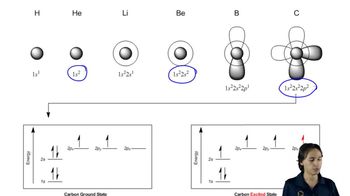
 02:53
02:53