Back

public flashcard up

1 student found this helpful
Control buttons has been changed to "navigation" mode.
1/20
  • What defines an organic molecule?_updated


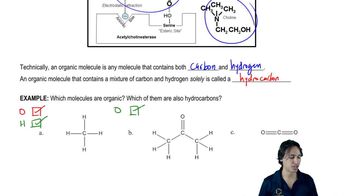
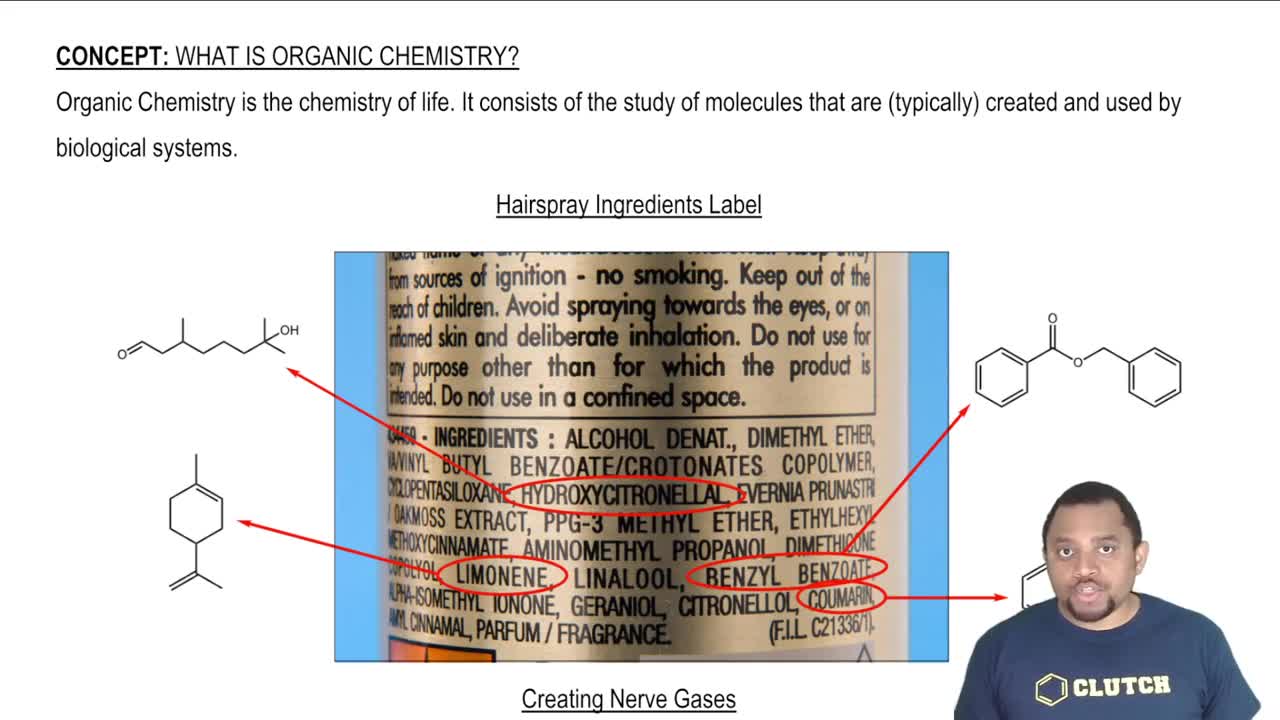
    An organic molecule contains both carbon and hydrogen. A molecule with only carbon and hydrogen is called a hydrocarbon.
  • How is the mass number of an atom calculated?

    Mass number = number of protons + number of neutrons.
  • What is the atomic number of an atom?

    The atomic number equals the number of protons in the nucleus.
  • What are isotopes?

    Atoms with the same atomic number but different numbers of neutrons.
  • What is an atomic orbital?

    A region of space within a shell that can hold a pair of electrons with opposite spins.
  • What are cations and anions?

    Cations are positively charged atoms (fewer electrons than protons). Anions are negatively charged atoms (more electrons than protons).
  • What does the Aufbau Principle state?

    Electrons fill orbitals in order of increasing energy.
  • What is the Pauli Exclusion Principle?

    An orbital can hold a maximum of two electrons with opposite spins.
  • What does Hund's Rule state?

    Electrons fill orbitals of equal energy singly before pairing up.
  • What is the Heisenberg Uncertainty Principle?

    It is impossible to simultaneously know an electron's exact position and momentum.
  • What is a wave function in quantum mechanics?

    A mathematical equation describing the energy state of an electron; its square gives the probability of finding the electron.
  • What is an atomic orbital shape?

    A 3D plot of the wave function showing regions where the probability of finding an electron is high.
  • What happens when atomic orbitals overlap constructively?

    They form bonding molecular orbitals with increased electron density between nuclei.
  • What is the Linear Combination of Atomic Orbitals (LCAO)?

    A method to mathematically combine atomic orbitals by addition or subtraction to form molecular orbitals.
  • What are sigma (σ) and pi (π) bonds?

    σ-bonds form by head-on overlap of orbitals; π-bonds form by side-on overlap of p orbitals.
  • What is the octet rule?

    Atoms tend to gain, lose, or share electrons to achieve a full valence shell of 8 electrons, like noble gases.
  • How many octet electrons do first-row elements like H, He, and Li prefer?

    They prefer to have 2 octet electrons.
  • What are formal charges? tet


    Formal charge = Group number - (number of valence electrons + number of bonds). It helps determine the most stable Lewis structure.
  • What is a skeletal (bondline) structure?

    A simplified organic structure where carbons are implied at line ends and hydrogens on carbons are usually omitted.
  • When must hydrogens be drawn explicitly in skeletal structures?

    Hydrogens attached to heteroatoms (non-carbons) must always be drawn explicitly.