Ch. 20 - Carboxylic Acids
Wade - Organic Chemistry 9th Edition
Wade9th EditionOrganic ChemistryISBN: 9780135213728Not the one you use?Change textbook
Chapter 20, Problem 44a,b

Two of the methods for converting alkyl halides to carboxylic acids are covered in Sections 20-8B and 20-8C. One is formation of a Grignard reagent followed by addition of carbon dioxide and then dilute acid. The other is substitution by cyanide ion, followed by hydrolysis of the resulting nitrile. For each of the following conversions, decide whether either or both of these methods would work, and explain why. Show the reactions you would use.
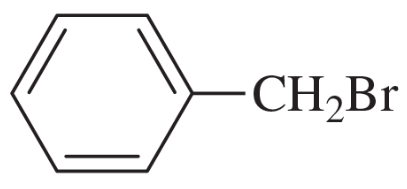
(a)
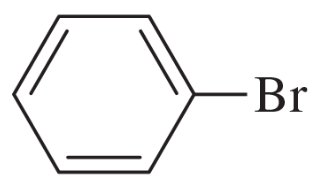
(b)

Verified step by step guidance
1
Step 1: Analyze the structures of the given alkyl halides in (a) and (b). In (a), the compound is benzyl bromide (C6H5CH2Br), which has a benzylic bromine atom. In (b), the compound is bromobenzene (C6H5Br), where the bromine atom is directly attached to the aromatic ring.
Step 2: For (a), benzyl bromide can undergo both methods of conversion to a carboxylic acid. (i) Grignard reagent formation: React benzyl bromide with magnesium (Mg) in dry ether to form the Grignard reagent (C6H5CH2MgBr). Then, add carbon dioxide (CO2) to the Grignard reagent, followed by hydrolysis with dilute acid, to yield benzoic acid (C6H5COOH). (ii) Cyanide substitution: React benzyl bromide with sodium cyanide (NaCN) to form benzyl cyanide (C6H5CH2CN). Hydrolyze the nitrile group using aqueous acid or base to yield benzoic acid.
Step 3: For (b), bromobenzene cannot undergo either method effectively. (i) Grignard reagent formation: Bromobenzene can react with magnesium to form phenylmagnesium bromide (C6H5MgBr), but the addition of CO2 and subsequent hydrolysis would yield benzoic acid. However, this is not a direct conversion of bromobenzene to a carboxylic acid, as the aromatic bromine is not replaced. (ii) Cyanide substitution: Bromobenzene cannot undergo nucleophilic substitution with cyanide ion (NaCN) because the aromatic bromine is not reactive in this context due to the stability of the aromatic ring.
Step 4: Summarize the results. For (a), both methods (Grignard reagent formation and cyanide substitution) are viable for converting benzyl bromide to benzoic acid. For (b), neither method is effective for converting bromobenzene to a carboxylic acid due to the lack of reactivity of the aromatic bromine.
Step 5: Write the reactions for (a). (i) Grignard method: C6H5CH2Br + Mg → C6H5CH2MgBr; C6H5CH2MgBr + CO2 → C6H5COOMgBr; C6H5COOMgBr + H2O → C6H5COOH. (ii) Cyanide method: C6H5CH2Br + NaCN → C6H5CH2CN; C6H5CH2CN + 2H2O → C6H5COOH + NH3.

Verified video answer for a similar problem:

This video solution was recommended by our tutors as helpful for the problem above.
Video duration:
12m
Was this helpful?

Key Concepts

Here are the essential concepts you must grasp in order to answer the question correctly.

Grignard Reagents

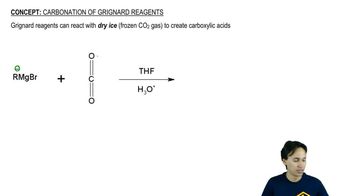
Grignard reagents are organomagnesium compounds formed by reacting alkyl or aryl halides with magnesium metal. They are highly reactive nucleophiles that can add to electrophiles, such as carbon dioxide, to form carboxylic acids upon subsequent hydrolysis. Understanding their formation and reactivity is crucial for converting alkyl halides to carboxylic acids.
Recommended video:
Guided course
02:12
Carbonation of Grignard Reagents

Nucleophilic Substitution

Nucleophilic substitution is a fundamental reaction mechanism in organic chemistry where a nucleophile replaces a leaving group in a molecule. In the context of converting alkyl halides to carboxylic acids, cyanide ion acts as a nucleophile, substituting the halide to form a nitrile, which can then be hydrolyzed to yield the desired carboxylic acid. This concept is essential for understanding the alternative method of conversion.
Recommended video:
Guided course
01:47
Nucleophiles and Electrophiles can react in Substitution Reactions.

Hydrolysis of Nitriles

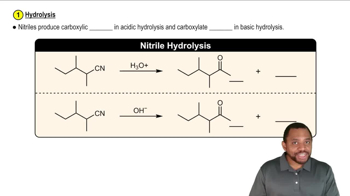
Hydrolysis of nitriles involves the reaction of nitriles with water, often in the presence of an acid or base, to convert them into carboxylic acids. This process is significant in the context of the second method for converting alkyl halides to carboxylic acids, as it allows for the transformation of the nitrile intermediate formed from nucleophilic substitution. Mastery of this reaction is key to successfully applying the method.
Recommended video:
1:09
Review of Nitriles Concept 6