Skip to main content
Personal Health
My Course
Learn
Exam Prep
AI Tutor
Study Guides
Flashcards
Try the app
My Course
Learn
Exam Prep
AI Tutor
Study Guides
Flashcards
Try the app
Back
Alcohol Overview definitions
You can tap to flip the card.
Ethanol
You can tap to flip the card.
👆
Ethanol
Primary component in alcoholic beverages responsible for physiological and behavioral effects when consumed.
Track progress
Control buttons has been changed to "navigation" mode.
1/15
Related flashcards
Related practice
Recommended videos
Alcohol Overview quiz
Alcohol Overview
20 Terms
Alcohol Overview
Ch.8 Alcohol and Tobacco
5 problems
Topic
Nicole
Alcohol and Health
Ch.8 Alcohol and Tobacco
5 problems
Topic
Laura
Ch.8 Alcohol and Tobacco
4 topics
12 problems
Chapter
Nicole
Guided course
1:46
Introduction Example 1
56
views
1
rank
Guided course
2:04
Introduction Concept 1
72
views
1
rank
Guided course
3:37
Alcohol Absorption & Metabolism Concept 2
81
views
Terms in this set (15)
Hide definitions
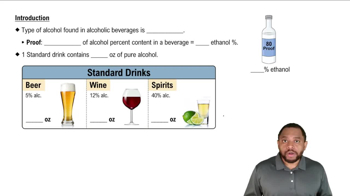
Ethanol
Primary component in alcoholic beverages responsible for physiological and behavioral effects when consumed.
Proof
Measurement system for alcohol content in beverages, calculated as twice the ethanol percentage.
Standard Drink
Unit containing approximately 0.6 ounces of pure alcohol, with volume and percentage varying by beverage type.
Beer
Alcoholic beverage typically containing 5% alcohol by volume, with a standard serving size of 12 ounces.
Wine
Alcoholic beverage generally containing 12% alcohol by volume, with a standard serving size of 5 ounces.
Spirits
Alcoholic beverages, such as liquors, usually containing 40% alcohol by volume, with a standard serving size of 1.5 ounces.
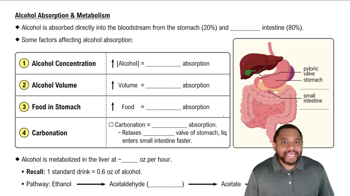
Small Intestine
Primary site for alcohol absorption, responsible for about 80% of ethanol entering the bloodstream.
Pyloric Valve
Stomach structure whose relaxation allows faster movement of alcohol into the small intestine, increasing absorption rate.
Acetaldehyde
Toxic intermediate produced during ethanol metabolism in the liver, later converted to less harmful substances.
Blood Alcohol Concentration
Ratio of alcohol to total blood volume, indicating levels of impairment and legal driving limits.
Impairment
State of reduced judgment, motor skills, and alertness resulting from elevated blood alcohol concentration.
Alcohol Poisoning
Dangerous condition caused by excessive blood alcohol concentration, potentially leading to coma or death.
Body Fat
Tissue type that displaces water, resulting in higher blood alcohol concentration due to lower total blood volume.
Water Content
Amount of water in the body, which dilutes alcohol and lowers blood alcohol concentration.
Sex
Biological factor influencing blood alcohol concentration, with women generally experiencing higher levels than men.
 BackBack

 1:46
1:46