Skip to main content
Personal Health
My Course
Learn
Exam Prep
AI Tutor
Study Guides
Flashcards
Try the app
My Course
Learn
Exam Prep
AI Tutor
Study Guides
Flashcards
Try the app
Back
Drug Categories quiz
You can tap to flip the card.
What are the seven main drug categories discussed in personal health?
You can tap to flip the card.
👆
What are the seven main drug categories discussed in personal health?
The seven categories are stimulants, depressants, opioids, cannabis, hallucinogens, inhalants, and anabolic steroids.
Track progress
Control buttons has been changed to "navigation" mode.
1/20
Related flashcards
Related practice
Recommended videos
Drug Categories definitions
Drug Categories
15 Terms
Drug Categories quiz #1
Drug Categories
10 Terms
Drug Categories
Ch.9 Drugs
5 problems
Topic
Nicole
Drug Interactions
Ch.9 Drugs
2 problems
Topic
Laura
Ch.9 Drugs
5 topics
13 problems
Chapter
Laura
Guided course
3:44
Stimulants, Depressants, Opioids Concept 1
91
views
Guided course
2:37
Cannabis, Hallucinogens, Inhalants Concept 2
55
views
Guided course
1:19
Cannabis, Hallucinogens, Inhalants Example 2
44
views
Terms in this set (20)
Hide definitions
What are the seven main drug categories discussed in personal health?
The seven categories are stimulants, depressants, opioids, cannabis, hallucinogens, inhalants, and anabolic steroids.
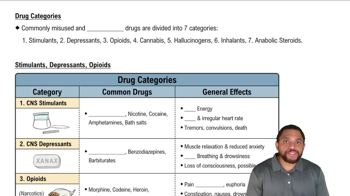
What is the primary effect of stimulants on the central nervous system?
Stimulants increase activity in the central nervous system, leading to increased energy and alertness.
Name two common stimulants mentioned in the lesson.
Caffeine and nicotine are two common stimulants.
What can long-term misuse of stimulants lead to?
Long-term misuse can cause irregular heart rate, tremors, convulsions, and even death.
How does nicotine act differently in short-term versus long-term use?
Short-term, nicotine acts as a stimulant; long-term use can make it act as a depressant.
What is the main effect of depressants on the body?
Depressants slow down the central nervous system, causing relaxation and reduced anxiety.
Give two examples of depressants.
Alcohol and benzodiazepines (such as Xanax) are examples of depressants.
What are the risks of abusing depressants?
Abuse can lead to loss of consciousness and, in extreme cases, death.
What is the primary medical use of opioids?
Opioids are primarily used for pain relief.
List two opioids mentioned in the lesson.
Morphine and fentanyl are two opioids mentioned.
What are the dangers of mixing opioids and depressants?
Mixing them can dangerously decrease breathing, increasing the risk of death.
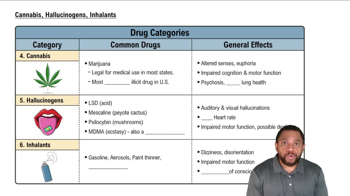
What is cannabis commonly known as, and what is its legal status in many states?
Cannabis is commonly known as marijuana and is legal for medical use in more than half of U.S. states.
What are some effects of cannabis use?
Cannabis can cause altered senses, euphoria, impaired cognition, and decreased lung health.
What is a hallucinogen, and name one example.
Hallucinogens are drugs that cause hallucinations; LSD is one example.
What are possible effects of hallucinogen use?
Effects include auditory and visual hallucinations, increased heart rate, and impaired motor function.
Why are inhalants considered dangerous?
Inhalants deliver drugs to the bloodstream very quickly, increasing the risk of dizziness, disorientation, and loss of consciousness.
Name two examples of inhalants.
Gasoline and aerosols are examples of inhalants.
What are anabolic steroids also known as?
Anabolic steroids are also called performance enhancing drugs or ergogenic drugs.
What is the main effect of anabolic steroids on the body?
They increase muscle mass and strength.
What are some risks associated with anabolic steroid abuse?
Risks include acne, liver damage, and increased risk of stroke or heart attack due to heart enlargement.
 BackBack

 3:44
3:44