Skip to main content
Personal Health
My Course
Learn
Exam Prep
AI Tutor
Study Guides
Flashcards
Try the app
My Course
Learn
Exam Prep
AI Tutor
Study Guides
Flashcards
Try the app
Back
Drug Effects on the Body quiz
You can tap to flip the card.
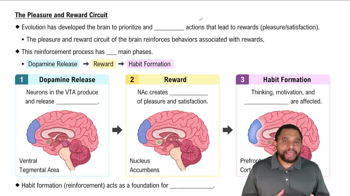
What neurotransmitter is primarily involved in the brain's pleasure and reward circuit related to addiction?
You can tap to flip the card.
👆
What neurotransmitter is primarily involved in the brain's pleasure and reward circuit related to addiction?
Dopamine is the main neurotransmitter involved, acting as a chemical messenger that impacts emotions and reinforces pleasurable behaviors.
Track progress
Control buttons has been changed to "navigation" mode.
1/20
Related flashcards
Related practice
Recommended videos
Drug Effects on the Body definitions
Drug Effects on the Body
15 Terms
Drug Effects on the Body
Ch.9 Drugs
5 problems
Topic
Laura
Drug Categories
Ch.9 Drugs
5 problems
Topic
Nicole
Ch.9 Drugs
5 topics
13 problems
Chapter
Laura
Guided course
1:33
Factors Affecting Drug Action Example 3
52
views
Guided course
3:56
How Drugs Affect the Brain Concept 2
51
views
1
rank
Guided course
3:21
The Pleasure and Reward Circuit Concept 1
66
views
1
rank
Terms in this set (20)
Hide definitions
What neurotransmitter is primarily involved in the brain's pleasure and reward circuit related to addiction?
Dopamine is the main neurotransmitter involved, acting as a chemical messenger that impacts emotions and reinforces pleasurable behaviors.
Which area of the brain produces and releases dopamine?
The ventral tegmental area (VTA) is responsible for producing and releasing dopamine.
What role does the nucleus accumbens (NAC) play in addiction?
The nucleus accumbens creates feelings of pleasure and satisfaction, reinforcing reward-related behaviors.
Which part of the brain is involved in habit formation related to addiction?
The prefrontal cortex is involved in habit formation, affecting thinking, motivation, and behavior.
Why is addiction considered difficult to overcome from an evolutionary perspective?
The brain is hardwired to pursue pleasure and satisfaction, making it challenging to resist addictive behaviors.
What are the three main phases of the brain's reinforcement process in addiction?
The phases are dopamine release, reward, and habit formation.
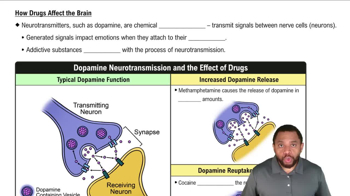
How do neurotransmitters like dopamine function in the brain?
Neurotransmitters are chemical messengers that transmit signals between neurons, impacting emotions when they attach to receptors.
How do addictive substances interfere with neurotransmission?
Addictive substances can alter the release, uptake, or reuptake of neurotransmitters like dopamine, affecting pleasure and satisfaction.
What effect does methamphetamine have on dopamine release?
Methamphetamine causes the release of dopamine in greater amounts, leading to increased feelings of pleasure.
How does cocaine affect dopamine reuptake?
Cocaine blocks the dopamine reuptake pump, preventing dopamine from being reabsorbed and prolonging its effects.
What is the synapse in the context of neurotransmission?
The synapse is the gap between transmitting and receiving neurons where neurotransmitters like dopamine travel.
What are the main factors that affect drug action in the body?
Dosage, physical factors (such as weight, body composition, and biochemistry), and route of administration affect drug action.
How does dosage influence the effect of a drug?
A larger dosage typically results in a greater effect, while a smaller dosage leads to a smaller effect.
How does body weight affect drug response?
Individuals with less body weight may experience a greater effect from a drug compared to those with more body weight.
What is the impact of body composition on drug concentration?
Body composition, such as muscle-to-fat ratio, affects drug concentration in the blood and can influence drug effects.
How does body biochemistry influence drug metabolism?
The rate of metabolism varies among individuals, affecting how long a drug stays in the system and its overall impact.
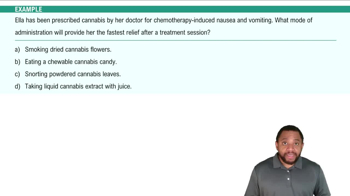
What is the fastest route of drug administration?
Inhalation is typically the fastest, with effects occurring in about 7 to 10 seconds.
How long does it take for a drug to take effect when ingested?
Ingestion usually takes about 30 minutes for the drug to take effect.
Which route of administration delivers drugs into the bloodstream in 15 to 30 seconds?
Intravenous injection delivers drugs into the bloodstream in 15 to 30 seconds.
Why is understanding drug effects on the body important for addressing addiction?
It helps explain the psychological and physiological challenges of overcoming compulsive behaviors and the risks of substance use.
 BackBack

 1:33
1:33