Skip to main content
Personal Health
My Course
Learn
Exam Prep
AI Tutor
Study Guides
Flashcards
Try the app
My Course
Learn
Exam Prep
AI Tutor
Study Guides
Flashcards
Try the app
Back
Essential Macronutrients definitions
You can tap to flip the card.
Carbohydrate
You can tap to flip the card.
👆
Carbohydrate
Primary energy source, broken down into glucose and stored as glycogen in liver and muscles; includes simple and complex forms.
Track progress
Control buttons has been changed to "navigation" mode.
1/17
Related flashcards
Related practice
Recommended videos
Essential Macronutrients quiz
Essential Macronutrients
20 Terms
Essential Macronutrients quiz #1
Essential Macronutrients
10 Terms
Essential Macronutrients
Ch.5 Nutrition Basics
5 problems
Topic
Laura
Essential Micronutrients
Ch.5 Nutrition Basics
5 problems
Topic
Nicole
Ch.5 Nutrition Basics - Part 1 of 2
4 topics
8 problems
Chapter
Nicole
Ch.5 Nutrition Basics - Part 2 of 2
3 topics
8 problems
Chapter
Nicole
Guided course
00:59
Fats (Lipids) Example 3
55
views
Guided course
1:59
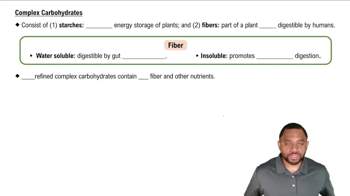
Complex Carbohydrates Concept 2
64
views
Guided course
3:13
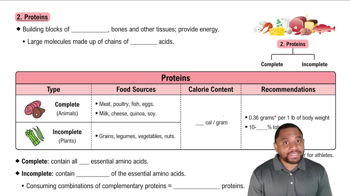
Proteins Concept 3
56
views
Terms in this set (17)
Hide definitions
Carbohydrate
Primary energy source, broken down into glucose and stored as glycogen in liver and muscles; includes simple and complex forms.
Glucose
Basic sugar molecule derived from carbohydrates, fuels cellular activities and is stored as glycogen for later energy use.
Glycogen
Storage form of glucose, composed of many glucose units, found mainly in liver and muscle tissue for energy reserves.
Simple Carbohydrate
Sugars with one or two molecules, found in fruits, dairy, and processed foods; quickly digested and provide rapid energy.
Complex Carbohydrate
Long chains of glucose molecules, present in grains, legumes, and vegetables; provide sustained energy and dietary fiber.
Starch
Main energy storage molecule in plants, made of numerous glucose units; a major component of complex carbohydrates.
Fiber
Indigestible plant component, aids digestion and satiety; includes soluble and insoluble types, supporting gut health.
Protein
Large molecule made of amino acids, essential for building muscle, bone, and tissue; provides energy and supports growth.
Amino Acid
Building block of proteins, required for tissue repair and growth; nine are essential and must be obtained from diet.
Complete Protein
Contains all nine essential amino acids, typically found in animal products and select plant sources like quinoa and soy.
Incomplete Protein
Lacks one or more essential amino acids, commonly found in plant foods; can be combined for full amino acid profile.
Fat
Highest energy-yielding macronutrient, includes saturated, unsaturated, and trans types; vital for cell structure and hormone production.
Triglyceride
Most common dietary and body fat, consists of three fatty acids attached to glycerol; main form of stored energy.
Saturated Fat
Solid at room temperature, mainly from animal sources; excessive intake linked to increased heart disease risk.
Unsaturated Fat
Liquid at room temperature, primarily from plants; includes monounsaturated and polyunsaturated forms, beneficial for heart health.
Trans Fat
Artificially created during hydrogenation, raises LDL and lowers HDL cholesterol; banned due to health risks.
Water
Calorie-free macronutrient, essential for temperature regulation, nutrient absorption, and overall bodily function.
 BackBack


 00:59
00:59