Skip to main content
Personal Health
My Course
Learn
Exam Prep
AI Tutor
Study Guides
Flashcards
Try the app
My Course
Learn
Exam Prep
AI Tutor
Study Guides
Flashcards
Try the app
Back
Essential Micronutrients definitions
You can tap to flip the card.
Micronutrients
You can tap to flip the card.
👆
Micronutrients
Compounds required in small quantities to support vital physiological functions and maintain overall health.
Track progress
Control buttons has been changed to "navigation" mode.
1/15
Related flashcards
Related practice
Recommended videos
Essential Micronutrients quiz
Essential Micronutrients
20 Terms
Essential Micronutrients
Ch.5 Nutrition Basics
5 problems
Topic
Nicole
Antioxidants
Ch.5 Nutrition Basics
1 problem
Topic
Laura
Ch.5 Nutrition Basics - Part 1 of 2
4 topics
8 problems
Chapter
Nicole
Ch.5 Nutrition Basics - Part 2 of 2
3 topics
8 problems
Chapter
Nicole
Guided course
1:26
Minerals Concept 2
47
views
Guided course
2:29
Vitamins Concept 1
52
views
Guided course
1:09
Essential Micronutrients Example 1
39
views
Terms in this set (15)
Hide definitions
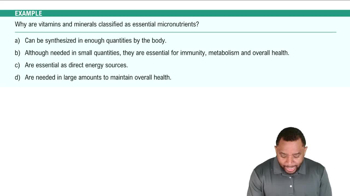
Micronutrients
Compounds required in small quantities to support vital physiological functions and maintain overall health.
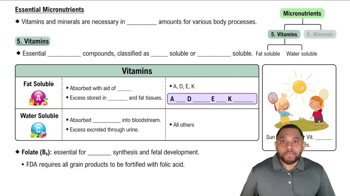
Vitamins
Organic substances classified by solubility, crucial for metabolic processes and body maintenance.
Fat-soluble Vitamins
Nutrients absorbed with dietary fat, stored in liver and adipose tissue, including A, D, E, and K.
Water-soluble Vitamins
Compounds absorbed directly into the bloodstream, with excess eliminated via urine.
Vitamin D
Nutrient synthesized through sun exposure, essential for bone health and calcium regulation.
Folate
B vitamin vital for genetic material production and fetal neural development.
Folic Acid
Synthetic form of a B vitamin added to grains to prevent birth defects related to neural tube formation.
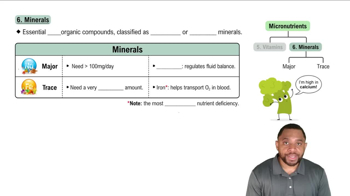
Minerals
Inorganic elements necessary for body structure, fluid balance, and metabolic reactions.
Major Minerals
Elements required in amounts exceeding 100 milligrams daily, supporting functions like fluid regulation.
Trace Minerals
Elements needed in minute quantities, often involved in specialized physiological roles.
Iron
Element crucial for oxygen transport in blood, with deficiency being the most prevalent nutrient shortfall.
Calcium
Inorganic element found in foods like broccoli, essential for bone structure and muscle function.
Sodium
Major mineral important for maintaining fluid equilibrium and nerve signaling.
Neural Tube Defects
Birth abnormalities prevented by adequate intake of certain B vitamins during pregnancy.
Liver
Organ responsible for storing excess fat-soluble nutrients and aiding in metabolic regulation.
 BackBack

 1:26
1:26