Skip to main content
Personal Health
My Course
Learn
Exam Prep
AI Tutor
Study Guides
Flashcards
Try the app
My Course
Learn
Exam Prep
AI Tutor
Study Guides
Flashcards
Try the app
Back
Health Benefits of Exercise definitions
You can tap to flip the card.
Cardiorespiratory Fitness
You can tap to flip the card.
👆
Cardiorespiratory Fitness
Improved efficiency of heart and lungs, leading to better oxygen delivery and endurance during physical activity.
Track progress
Control buttons has been changed to "navigation" mode.
1/15
Related flashcards
Related practice
Recommended videos
Health Benefits of Exercise quiz
Health Benefits of Exercise
20 Terms
Health Benefits of Exercise quiz #1
Health Benefits of Exercise
34 Terms
Health Benefits of Exercise
Ch.7 Exercise and Fitness
5 problems
Topic
Nicole
Principles of Physical Training
Ch.7 Exercise and Fitness
5 problems
Topic
Ally
Ch.7 Exercise and Fitness
4 topics
12 problems
Chapter
Laura
Guided course
3:18
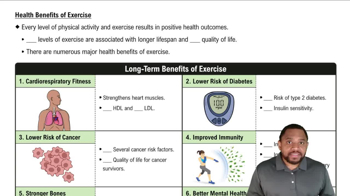
Health Benefits of Exercise Concept 1
65
views
Guided course
2:02
2018 HHS Physical Activity Guidelines Concept 2
44
views
Guided course
1:20
Health Benefits of Exercise Example 1
54
views
Terms in this set (15)
Hide definitions
Cardiorespiratory Fitness
Improved efficiency of heart and lungs, leading to better oxygen delivery and endurance during physical activity.
Type 2 Diabetes
Chronic condition marked by high blood sugar levels, often reduced by regular physical activity and increased insulin sensitivity.
Cancer Risk
Likelihood of developing malignant growths, which can be lowered through consistent exercise and healthy lifestyle choices.
Immunity
Body’s defense system against infections, strengthened by regular exercise and reduced inflammation.
Bone Density
Measurement of mineral content in bones, maintained and improved by weight-bearing physical activities.
Mental Health
State of emotional and psychological well-being, enhanced by exercise through better cognitive function and reduced anxiety.
HDL
Type of cholesterol known as 'good' cholesterol, increased by exercise and beneficial for heart health.
LDL
Type of cholesterol known as 'bad' cholesterol, decreased by regular physical activity to lower heart disease risk.
Insulin Sensitivity
Body’s ability to respond to insulin, improved by exercise and crucial for blood sugar regulation.
Inflammation
Body’s response to injury or infection, often reduced by regular physical activity, supporting overall health.
Osteoporosis
Condition characterized by weak and brittle bones, prevented or delayed by maintaining bone density through exercise.
Cognitive Function
Ability to think, learn, and solve problems, which is enhanced by regular physical activity.
Anxiety
Feeling of worry or unease, often alleviated by consistent exercise routines.
Depression
Mood disorder marked by persistent sadness, which can be reduced through regular physical activity.
Sedentary Activities
Behaviors involving minimal physical movement, such as sitting, which should be limited to promote health.
 BackBack


 3:18
3:18