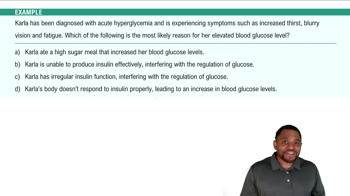
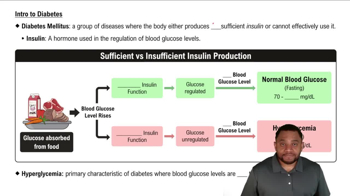
Diabetes mellitus is a group of diseases characterized by insufficient insulin production or ineffective insulin use, leading to high blood glucose levels.
What hormone is primarily involved in regulating blood glucose levels?
Insulin is the hormone responsible for regulating blood glucose levels.
What happens to blood glucose levels after eating in a person with normal insulin function?
Blood glucose levels rise after eating but are regulated and decrease over time due to normal insulin function.
What is hyperglycemia?
Hyperglycemia is a condition where blood glucose levels are higher than normal, typically above 100 mg/dL after fasting.
What is the normal fasting blood glucose range?
Normal fasting blood glucose levels are between 70 and 100 mg/dL.
What blood glucose range indicates prediabetes?
Prediabetes is indicated by fasting blood glucose levels between 101 and 125 mg/dL.
At what fasting blood glucose level is diabetes diagnosed?
Diabetes is diagnosed when fasting blood glucose is greater than or equal to 126 mg/dL.
What can happen if prediabetes is not treated?
If prediabetes is not treated, it can progress to diabetes.
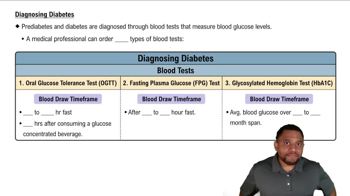
What is the purpose of the oral glucose tolerance test (OGTT)?
The OGTT measures how well the body processes glucose after fasting and consuming a glucose-rich beverage.
How long must a person fast before taking the OGTT?
A person must fast for 8 to 12 hours before taking the OGTT.
What is the fasting plasma glucose (FPG) test?
The FPG test measures blood glucose after an 8 to 10 hour fast without consuming a glucose beverage.
What does the glycosylated hemoglobin (HbA1c) test measure?
The HbA1c test measures the average blood glucose level over the past two to three months.
Does the HbA1c test require fasting?
No, the HbA1c test does not require fasting.
Why is insulin important for blood glucose regulation?
Insulin helps lower blood glucose levels by allowing cells to absorb glucose from the bloodstream.
What is a key characteristic of diabetes?
A key characteristic of diabetes is hyperglycemia, or high blood glucose levels.
What is the main difference between prediabetes and diabetes?
Prediabetes involves elevated blood glucose levels not high enough for a diabetes diagnosis, while diabetes involves even higher levels.
What is the main risk of having prediabetes?
The main risk is that prediabetes can develop into diabetes if not managed.
What are the three main blood tests used to diagnose diabetes?
The three main tests are the OGTT, FPG, and HbA1c tests.
What does a diagnosis of prediabetes usually lead to?
A diagnosis of prediabetes usually leads to a treatment plan to prevent progression to diabetes.
What does the OGTT involve after fasting?
After fasting, the OGTT involves drinking a glucose-rich beverage and measuring blood glucose two hours later.
 Back
Back


 2:35
2:35