Skip to main content
Personal Health
My Course
Learn
Exam Prep
AI Tutor
Study Guides
Flashcards
Try the app
My Course
Learn
Exam Prep
AI Tutor
Study Guides
Flashcards
Try the app
Back
Introduction to Dietary Reference Intakes definitions
You can tap to flip the card.
Dietary Reference Intakes
You can tap to flip the card.
👆
Dietary Reference Intakes
Scientifically developed values guiding essential nutrient intake to prevent deficiencies and chronic diseases.
Track progress
Control buttons has been changed to "navigation" mode.
1/15
Related flashcards
Related practice
Recommended videos
Introduction to Dietary Reference Intakes quiz
Introduction to Dietary Reference Intakes
20 Terms
Introduction to Dietary Reference Intakes
Ch.5 Nutrition Basics
2 problems
Topic
Nicole
Essential Macronutrients
Ch.5 Nutrition Basics
5 problems
Topic
Laura
Ch.5 Nutrition Basics - Part 1 of 2
4 topics
8 problems
Chapter
Nicole
Ch.5 Nutrition Basics - Part 2 of 2
3 topics
8 problems
Chapter
Nicole
Guided course
4:21
Introduction to Dietary Reference Intakes (DRIs) Concept 1
92
views
Guided course
2:10
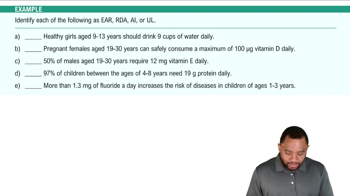
Introduction to Dietary Reference Intakes (DRIs) Example 1
93
views
1
rank
Terms in this set (15)
Hide definitions
Dietary Reference Intakes
Scientifically developed values guiding essential nutrient intake to prevent deficiencies and chronic diseases.
Nutritional Deficiency
State resulting from insufficient intake of essential nutrients, increasing risk for health problems.
Chronic Disease
Long-term health condition often linked to poor nutrition or imbalanced nutrient intake.
Estimated Average Requirement
Average daily nutrient amount needed by half of a specific population group.
Recommended Dietary Allowance
Daily nutrient level sufficient for nearly all healthy individuals in a group.
Adequate Intake
Estimated nutrient amount considered sufficient for healthy people when evidence is lacking for a precise value.
Tolerable Upper Intake Level
Maximum daily nutrient amount unlikely to cause adverse health effects or toxicity.
Acceptable Macronutrient Distribution Range
Range of macronutrient intake associated with reduced risk of chronic diseases.
Essential Nutrient
Substance required for normal body function that must be obtained from the diet.
Toxicity
Condition resulting from excessive intake of nutrients, leading to harmful effects.
Sufficient Nutrition
Optimal intake level of nutrients supporting health without deficiency or excess.
Reference Value
Scientifically established guideline for nutrient intake used to assess dietary adequacy.
Macronutrient
Nutrient category including carbohydrates, proteins, and fats, required in large amounts.
Body Weight
Measurement used to determine appropriate nutrient intake levels for individuals.
Optimal Nutrition
Balanced intake of nutrients promoting health and preventing disease.
 BackBack

 4:21
4:21