Skip to main content
Personal Health
My Course
Learn
Exam Prep
AI Tutor
Study Guides
Flashcards
Try the app
My Course
Learn
Exam Prep
AI Tutor
Study Guides
Flashcards
Try the app
Back
Planning a Healthy Diet quiz
You can tap to flip the card.
Who regulates food labels in the United States?
You can tap to flip the card.
👆
Who regulates food labels in the United States?
The Food and Drug Administration (FDA) regulates food labels in the United States.
Track progress
Control buttons has been changed to "navigation" mode.
1/20
Related flashcards
Related practice
Recommended videos
Planning a Healthy Diet definitions
Planning a Healthy Diet
14 Terms
Planning a Healthy Diet
Ch.5 Nutrition Basics
5 problems
Topic
Nicole
Nutritional Guidelines
Ch.5 Nutrition Basics
4 problems
Topic
Nicole
Ch.5 Nutrition Basics - Part 1 of 2
4 topics
8 problems
Chapter
Nicole
Ch.5 Nutrition Basics - Part 2 of 2
3 topics
8 problems
Chapter
Nicole
Guided course
0:55
Food Label Claims Example 2
48
views
Guided course
1:10
Reading Food Labels Example 1
40
views
Guided course
0:55
Food Label Claims Concept 2
37
views
Terms in this set (20)
Hide definitions
Who regulates food labels in the United States?
The Food and Drug Administration (FDA) regulates food labels in the United States.
What is the main purpose of food labels?
Food labels provide information about a food's contents to help consumers make healthy decisions.
What is the difference between serving size and portion size?
Serving size is a standardized amount listed on the label, while portion size is the actual amount a person chooses to eat.
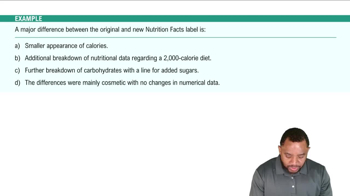
How did the display of calories change in the new food label format after 2016?
Calories are now displayed in a larger and bolder font to make them more noticeable.
What additional carbohydrate information is now included on the new food label?
The new label includes a line for added sugars, providing more detail about carbohydrate content.
How are vitamins and minerals displayed differently on the new food label?
The new label shows both the percentage and the actual amount (in milligrams) of vitamins and minerals.
What are the three types of food label claims?
The three types are structure/function claims, health claims, and nutrient content claims.
Which food label claim is the least regulated?
Structure/function claims are the least regulated.
What is an example of a structure/function claim?
An example is 'calcium helps build strong bones.'
What makes health claims more regulated than structure/function claims?
Health claims require preapproval by the FDA and must be backed by scientific evidence linking a food to a health benefit.
Give an example of a health claim on a food label.
An example is 'oatmeal can help lower cholesterol.'
What do nutrient content claims describe?
They describe the amount of a nutrient in a food, such as 'low fat' or 'high fiber.'
Which type of claim is most tightly regulated by the FDA and USDA?
Nutrient content claims are the most tightly regulated.
How can you estimate a one-cup serving size without utensils?
A closed fist is roughly equal to one cup, useful for grains, fruits, and vegetables.
What hand gesture estimates a three-ounce serving of meat?
An open palm is used to estimate a three-ounce serving of meat.
How can you estimate a half-cup serving size using your hand?
A cupped hand is about equal to a half-cup serving, often used for grains and dairy.
What does your thumb represent when estimating serving sizes?
Your thumb can estimate one tablespoon, useful for measuring dairy products like cottage cheese.
Why is understanding serving size important for a healthy diet?
It helps you calculate how much of each nutrient you are actually consuming.
What is the role of the Food and Nutrition Board in food labeling?
The Food and Nutrition Board updates the percentage values for nutrients on food labels.
Why is it important to distinguish between serving size and portion size?
Because portion size affects your actual intake, which may differ from the standardized serving size on the label.
 BackBack
 0:55
0:55