Skip to main content
Personal Health
My Course
Learn
Exam Prep
AI Tutor
Study Guides
Flashcards
Try the app
My Course
Learn
Exam Prep
AI Tutor
Study Guides
Flashcards
Try the app
Back
Positive Psychology quiz
You can tap to flip the card.
What is the main focus of positive psychology?
You can tap to flip the card.
👆
What is the main focus of positive psychology?
Positive psychology studies positive emotions, virtues, and character strengths that contribute to happiness and fulfillment.
Track progress
Control buttons has been changed to "navigation" mode.
1/20
Related flashcards
Related practice
Recommended videos
Positive Psychology definitions
Positive Psychology
15 Terms
Positive Psychology
Ch.2 Psychological Health
5 problems
Topic
Nicole
Psychological Disorders & Treatments
Ch.2 Psychological Health
5 problems
Topic
Laura
Ch.2 Psychological Health
4 topics
10 problems
Chapter
Nicole
Guided course
1:55
Positive Psychology and Happiness Example 4
50
views
Guided course
2:02
Positive Psychology Example 1
63
views
Guided course
1:27
Self-Actualized People Example 3
54
views
Terms in this set (20)
Hide definitions
What is the main focus of positive psychology?
Positive psychology studies positive emotions, virtues, and character strengths that contribute to happiness and fulfillment.
What question does positive psychology seek to answer about life?
It asks what makes life worth living and how we can find positives in our daily lives.
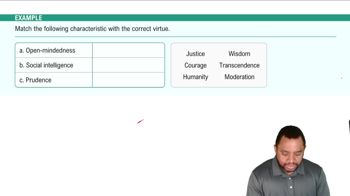
Name the six virtues identified in positive psychology.
The six virtues are wisdom, courage, humanity, justice, moderation, and transcendence.
What character strengths are associated with the virtue of wisdom?
Wisdom is associated with creativity, curiosity, and perspective.
Which character strengths are linked to the virtue of courage?
Courage includes bravery, honesty, and persistence.
What does the virtue of humanity emphasize?
Humanity emphasizes love and kindness towards oneself and others.
What are the key aspects of the virtue of justice?
Justice involves fairness and collaboration in teamwork.
List the character strengths associated with moderation.
Moderation includes modesty, forgiveness, and self-regulation.
What does transcendence represent in positive psychology?
Transcendence is the highest level of self-actualization, involving aesthetic sense, hope, and spirituality.
Who developed the hierarchy of needs model in psychology?
Abraham Maslow developed the hierarchy of needs model.
What is at the top of Maslow's hierarchy of needs?
Self-actualization is at the top of Maslow's hierarchy.
List the five levels of Maslow's hierarchy of needs in order.
The levels are survival needs, security needs, social needs, esteem needs, and self-actualization.
What are survival needs according to Maslow?
Survival needs include food, water, and sleep.
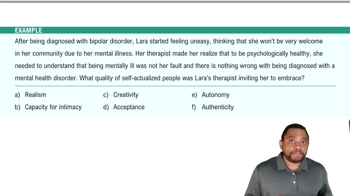
What qualities do self-actualized individuals share?
They share realism, authenticity, acceptance, creativity, autonomy, and capacity for intimacy.
How do self-actualized people demonstrate realism?
They differentiate between wants and needs and accept what can and cannot be changed.
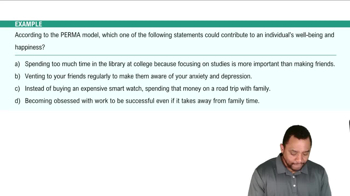
What is the PERMA model in positive psychology?
The PERMA model outlines five elements of well-being: positive emotions, engagement, relationships, meaning, and accomplishment.
What does 'engagement' mean in the PERMA model?
Engagement refers to being present in the moment and having passion and absorption in activities.
How is 'meaning' defined in the PERMA model?
Meaning involves striving to find a purpose in life and understanding there is something greater than oneself.
Which elements of the PERMA model contribute more to happiness than pleasure?
Engagement and meaning contribute more to happiness than pleasure.
How does positive psychology view happiness?
Happiness is seen as a complex emotion experienced differently by individuals, generally involving pleasure, engagement, and meaning.
 BackBack

 1:55
1:55