Skip to main content
Personal Health
My Course
Learn
Exam Prep
AI Tutor
Study Guides
Flashcards
Try the app
My Course
Learn
Exam Prep
AI Tutor
Study Guides
Flashcards
Try the app
Back
Risk Factors for Cardiovascular Disease definitions
You can tap to flip the card.
Cardiovascular Disease
You can tap to flip the card.
👆
Cardiovascular Disease
A group of conditions affecting the heart and blood vessels, often influenced by lifestyle and genetic factors.
Track progress
Control buttons has been changed to "navigation" mode.
1/15
Related flashcards
Related practice
Recommended videos
Risk Factors for Cardiovascular Disease quiz
Risk Factors for Cardiovascular Disease
20 Terms
Risk Factors for Cardiovascular Disease quiz #1
Risk Factors for Cardiovascular Disease
10 Terms
Risk Factors for Cardiovascular Disease
Ch.10 Major Diseases
5 problems
Topic
Laura
An Overview of Cancer
Ch.10 Major Diseases
5 problems
Topic
Laura
Ch.10 Major Diseases - Part 1 of 2
4 topics
9 problems
Chapter
Brendan
Ch.10 Major Diseases - Part 2 of 2
3 topics
8 problems
Chapter
Nicole
Guided course
1:50
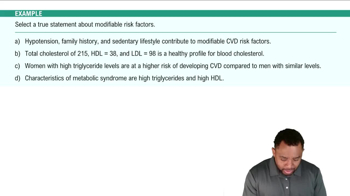
Modifiable Risk Factors Example 1
84
views
Guided course
4:49
Modifiable Risk Factors Concept 1
85
views
Guided course
2:01
Non-Modifiable Risk Factors Concept 2
90
views
Terms in this set (15)
Hide definitions
Cardiovascular Disease
A group of conditions affecting the heart and blood vessels, often influenced by lifestyle and genetic factors.
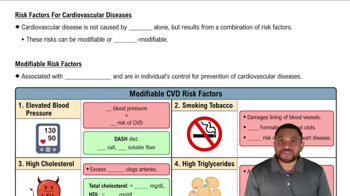
Modifiable Risk Factor
A characteristic or condition that can be changed or managed to reduce the likelihood of developing heart-related illnesses.
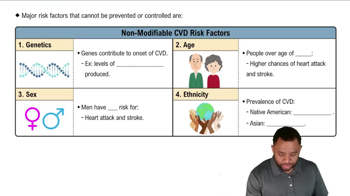
Non-modifiable Risk Factor
A trait or circumstance, such as genetics or age, that cannot be altered and impacts susceptibility to heart conditions.
Blood Pressure
The force exerted by circulating blood on vessel walls; higher levels increase the chance of heart problems.
DASH Diet
A dietary approach emphasizing reduced salt and increased fiber to help lower blood pressure and support heart health.
Smoking
A behavior that damages blood vessel linings, raises clot formation, and heightens risk for coronary heart disease.
Cholesterol
A fatty substance in blood; excess LDL can clog arteries, while HDL helps remove it, impacting heart health.
Triglyceride
A type of fat in the blood; elevated levels are linked to diabetes, obesity, and increased cardiovascular risk.
Diabetes
A metabolic condition that significantly raises the likelihood of heart disease, especially in women.
Obesity
A state of excessive body fat, often measured by BMI, that increases the risk of heart-related illnesses.
Physical Inactivity
A lack of regular movement or exercise, contributing to high blood pressure, low HDL, and weight gain.
Metabolic Syndrome
A cluster of conditions including abdominal obesity, high triglycerides, low HDL, high blood pressure, and elevated glucose.
Genetics
Inherited traits that influence cholesterol production and overall risk for heart conditions.
Sex
A biological factor; men generally face higher chances of heart attack and stroke compared to women.
Ethnicity
A demographic factor; certain groups, such as Native Americans, have higher rates of heart disease than others.
 BackBack


 1:50
1:50