Skip to main content
Personal Health
My Course
Learn
Exam Prep
AI Tutor
Study Guides
Flashcards
Try the app
My Course
Learn
Exam Prep
AI Tutor
Study Guides
Flashcards
Try the app
Back
Suicide definitions
You can tap to flip the card.
Mental Health Support
You can tap to flip the card.
👆
Mental Health Support
Professional assistance and resources available to individuals experiencing psychological distress or crisis.
Track progress
Control buttons has been changed to "navigation" mode.
1/15
Related flashcards
Related practice
Recommended videos
Suicide quiz
Suicide
20 Terms
Suicide
Ch.2 Psychological Health
3 problems
Topic
Nicole
Psychological Disorders & Treatments
Ch.2 Psychological Health
5 problems
Topic
Laura
Ch.2 Psychological Health
4 topics
10 problems
Chapter
Nicole
Guided course
1:46
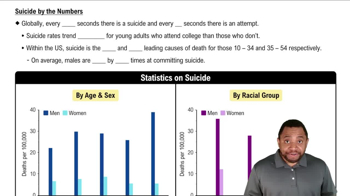
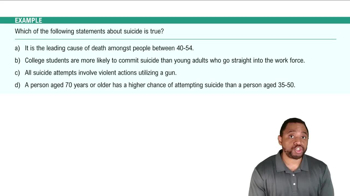
Suicide by the Numbers Example 1
60
views
Guided course
4:12
Suicide by the Numbers Concept 1
60
views
1
rank
Guided course
3:05
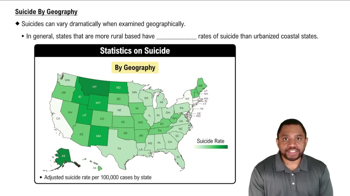
Suicide By Geography Concept 2
46
views
Terms in this set (15)
Hide definitions
Mental Health Support
Professional assistance and resources available to individuals experiencing psychological distress or crisis.
Suicide Rate
Statistical measure indicating the frequency of deaths by self-harm within a specific population and time frame.
Attempt
An act of self-harm that does not result in death but reflects significant psychological distress.
Education Access
Availability of learning opportunities shown to reduce risk factors associated with self-harm.
Age Group
Demographic category used to analyze trends, with older men showing the highest risk for self-harm.
Sex Disparity
Difference in self-harm rates between males and females, with males consistently exhibiting higher rates.
Racial Group
Population segment defined by ethnicity, with some groups, such as Native Americans, facing elevated risk.
Sexual Identity
Personal identification related to sexuality, with LGBTQIA+ individuals experiencing increased vulnerability.
Geography
Physical location influencing risk, with rural areas and certain states showing higher prevalence.
Isolation
State of limited social contact, often linked to increased psychological distress and risk.
Economic Inequality
Significant differences in wealth within a region, contributing to emotional hardship and risk.
Suicide Belt
Region in the US characterized by consistently high rates of self-harm, including states like Wyoming.
Altitude
Elevation above sea level, with research suggesting possible effects on brain chemistry and risk.
Cognition Decline
Reduction in mental abilities, often seen in older adults, contributing to increased vulnerability.
Marginalized Group
Community facing social disadvantage, such as LGBTQIA+ individuals, with heightened risk factors.
 BackBack

 1:46
1:46