Skip to main content
Personal Health
My Course
Learn
Exam Prep
AI Tutor
Study Guides
Flashcards
Try the app
My Course
Learn
Exam Prep
AI Tutor
Study Guides
Flashcards
Try the app
Back
The Major Cardiovascular Diseases quiz
You can tap to flip the card.
What is hypertension?
You can tap to flip the card.
👆
What is hypertension?
Hypertension is sustained elevated blood pressure, which can damage blood vessels and lead to other serious cardiovascular diseases.
Track progress
Control buttons has been changed to "navigation" mode.
1/20
Related flashcards
Related practice
Recommended videos
The Major Cardiovascular Diseases definitions
The Major Cardiovascular Diseases
17 Terms
The Major Cardiovascular Diseases quiz #1
The Major Cardiovascular Diseases
10 Terms
The Major Cardiovascular Diseases
Ch.10 Major Diseases
5 problems
Topic
Ally
Risk Factors for Cardiovascular Disease
Ch.10 Major Diseases
5 problems
Topic
Laura
Ch.10 Major Diseases - Part 1 of 2
4 topics
9 problems
Chapter
Brendan
Ch.10 Major Diseases - Part 2 of 2
3 topics
8 problems
Chapter
Nicole
Guided course
1:41
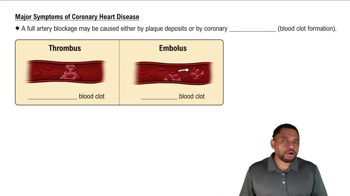
Major Symptoms of Coronary Heart Disease Concept 5
98
views
Guided course
2:11
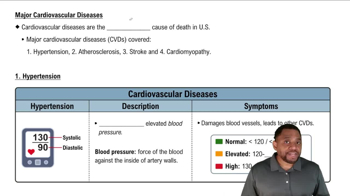
Hypertension Concept 1
120
views
1
rank
Guided course
1:35
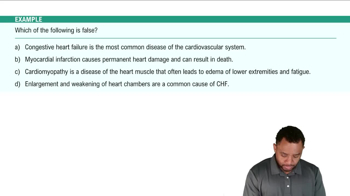
Cardiomyopathy Example 5
42
views
Terms in this set (20)
Hide definitions
What is hypertension?
Hypertension is sustained elevated blood pressure, which can damage blood vessels and lead to other serious cardiovascular diseases.
What are the normal systolic and diastolic blood pressure values?
Normal blood pressure is defined as a systolic value less than 120 and a diastolic value less than 80.
How is elevated blood pressure defined?
Elevated blood pressure is a systolic value between 120-129 and a diastolic value less than 80.
What systolic and diastolic values indicate hypertension?
Hypertension is indicated by a systolic value of 130-180 and a diastolic value of 80-120.
What is atherosclerosis?
Atherosclerosis is the narrowing and hardening of arteries due to plaque buildup on the inner walls.
What substances make up arterial plaque?
Plaque is made up of fatty substances such as cholesterol, calcium, and cellular waste.
What are the two main types of atherosclerosis-related diseases?
The two main types are peripheral artery disease and coronary heart disease.
What is peripheral artery disease?
Peripheral artery disease is atherosclerosis in the arteries of the limbs, especially the legs and arms.
What are common symptoms of peripheral artery disease?
Symptoms include cramping, aching in the legs, feet, arms, or hips, slow wound healing, and in severe cases, tissue death leading to amputation.
What is coronary heart disease?
Coronary heart disease is atherosclerosis in the coronary arteries, reducing or blocking blood flow to the heart.
What is angina pectoris?
Angina pectoris is severe chest pain caused by partial blockage of a coronary artery, leading to temporary discomfort.
What is a myocardial infarction?
A myocardial infarction, or heart attack, is the complete blockage of a coronary artery, causing permanent heart tissue death.
What are the symptoms of a heart attack?
Symptoms include chest pain, pain in the arms or jaw, shortness of breath, and sometimes unconsciousness or death.
What is the difference between a thrombus and an embolus?
A thrombus is a stationary blood clot, while an embolus is a blood clot that has broken off and travels through the bloodstream.
What is a stroke?
A stroke occurs when blood flow to the brain is blocked, resulting in brain tissue death and potentially permanent brain damage.
What are the two main types of strokes?
The two main types are ischemic (caused by a blood clot) and hemorrhagic (caused by a ruptured blood vessel).
What is an aneurysm?
An aneurysm is a bulge in the wall of a blood vessel that can rupture and cause a hemorrhagic stroke.
What are common symptoms of a stroke?
Symptoms include dizziness, weakness, speech impairment, memory loss, walking disability, paralysis, or death.
What is cardiomyopathy?
Cardiomyopathy is a condition where the heart muscle deteriorates and enlarges, making it unable to pump blood effectively.
What are symptoms of cardiomyopathy?
Symptoms include swelling in the legs, ankles, and feet, shortness of breath, fatigue, and it can lead to congestive heart failure if untreated.
 BackBack



 1:41
1:41