What are the six major harmful chemicals found in tobacco?
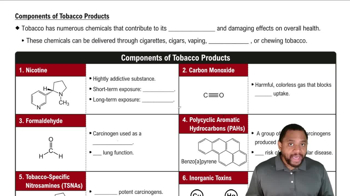
Nicotine, carbon monoxide, formaldehyde, polycyclic aromatic hydrocarbons (PAHs), tobacco-specific nitrosamines (TSNAs), and inorganic toxins are the six major harmful chemicals.
How does nicotine affect the body in the short term versus the long term?
Short-term exposure to nicotine acts as a stimulant, increasing blood pressure and heart rate, while long-term exposure acts as a depressant.
What is the primary addictive component of tobacco?
Nicotine is the primary addictive component of tobacco.
What dangerous effect does carbon monoxide have on the body?
Carbon monoxide blocks oxygen uptake, which can lead to suffocation.
Why is formaldehyde considered dangerous in tobacco products?
Formaldehyde is a carcinogen, meaning it causes cancer, and is also used as a preservative.
What are polycyclic aromatic hydrocarbons (PAHs) and why are they harmful?
PAHs are a group of over 100 carcinogens produced from burning tobacco, and they increase cancer risk.
What are tobacco-specific nitrosamines (TSNAs) and how are they formed?
TSNAs are potent carcinogens formed during the drying process of tobacco leaves.
Name two inorganic toxins found in tobacco and their health risks.
Copper and lead are examples; they can cause neurological damage and increase cancer risk.
How does nicotine trigger addiction in smokers?
Nicotine triggers the release of dopamine, leading to feelings of pleasure and dependence.
What are common withdrawal symptoms when quitting nicotine?
Withdrawal symptoms include restlessness, irritability, increased hunger, and anxiety.
How long do the most intense nicotine withdrawal symptoms typically last after quitting?
The hardest withdrawal symptoms usually occur during the first two to four weeks after quitting.
What is vaping and how does it differ from traditional smoking?
Vaping is inhaling vaporized nicotine using e-cigarettes, which deliver higher concentrations of nicotine more rapidly than traditional cigarettes.
Why might vaping be considered more dangerous than traditional smoking?
Vaping delivers a higher dose of nicotine, increasing addiction risk and potential adverse mental health effects.
What trend has been observed in traditional smoking rates in the US since 2005?
Traditional smoking rates have been decreasing among US adults since 2005.
Which gender tends to smoke at higher rates according to the data?
Men tend to smoke at higher rates than women.
How does education level correlate with smoking rates?
Higher levels of formal education are associated with lower smoking rates.
What impact does social pressure in educational settings have on smoking rates?
Social pressure and increased awareness in educational settings contribute to lower smoking rates.
What percentage of US adult deaths is attributed to smoking?
One out of every five US adult deaths is related to smoking.
Which racial/ethnic group has the lowest traditional smoking rates?
Non-Hispanic Asians have the lowest traditional smoking rates among men and women.
What is the current trend in the use of vape pens and nicotine pouches?
The use of vape pens and nicotine pouches is rising, while traditional smoking is declining.
 Back
Back


 1:29
1:29