
Ch. 19 - Heat and the First Law of Thermodynamics
Giancoli Douglas - Physics for Scientists and Engineers 5th edition
Giancoli Douglas5th editionPhysics for Scientists and EngineersISBN: 9780137488179Not the one you use?Change textbook
Chapter 19, Problem 19.14

(II) A 0.40-kg iron horseshoe just forged and very hot (Fig. 19–31), is dropped into 1.35 L of water in a 0.30-kg iron pot initially at 20.0°C. If the final equilibrium temperature is 25.0°C, estimate the initial temperature of the hot horseshoe..
<IMAGE>

Verified step by step guidance
1
Identify the specific heat capacities involved: For iron, it is approximately 0.450 J/g°C, and for water, it is approximately 4.186 J/g°C.
Convert the mass of water from liters to grams knowing that 1 liter of water has a mass of approximately 1000 grams.
Set up the heat transfer equation assuming no heat loss to the surroundings. The heat lost by the iron horseshoe and pot should equal the heat gained by the water. Use the formula: \(m_{\text{iron}} imes c_{\text{iron}} imes (T_{\text{final}} - T_{\text{initial, iron}}) + m_{\text{pot}} imes c_{\text{iron}} imes (T_{\text{final}} - T_{\text{initial, pot}}) = m_{\text{water}} imes c_{\text{water}} imes (T_{\text{final}} - T_{\text{initial, water}})\).
Plug in the known values: mass of the horseshoe, mass of the pot, specific heat of iron, mass of the water, specific heat of water, initial temperature of the water and pot, and the final equilibrium temperature.
Solve the equation for the initial temperature of the hot horseshoe, \(T_{\text{initial, iron}}\). This will involve isolating \(T_{\text{initial, iron}}\) on one side of the equation and then calculating its value.

Verified video answer for a similar problem:

This video solution was recommended by our tutors as helpful for the problem above.
Video duration:
9m
Was this helpful?

Key Concepts

Here are the essential concepts you must grasp in order to answer the question correctly.

Heat Transfer

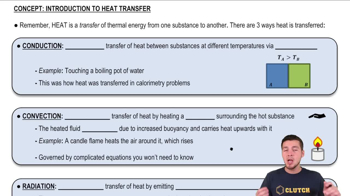
Heat transfer is the process by which thermal energy moves from one object to another due to a temperature difference. In this scenario, the hot iron horseshoe transfers heat to the cooler water and pot until thermal equilibrium is reached. Understanding the mechanisms of conduction, convection, and radiation is essential for analyzing how heat flows in this system.
Recommended video:
Guided course
05:14
Overview of Heat Transfer

Specific Heat Capacity

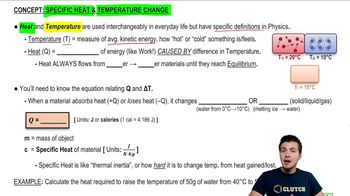
Specific heat capacity is the amount of heat required to raise the temperature of a unit mass of a substance by one degree Celsius. Each material has a unique specific heat capacity, which influences how much heat it can absorb or release. In this problem, knowing the specific heat capacities of iron and water is crucial for calculating the initial temperature of the horseshoe based on the heat exchanged.
Recommended video:
Guided course
06:50
Specific Heat & Temperature Changes

Thermal Equilibrium

Thermal equilibrium occurs when two objects in contact reach the same temperature, resulting in no net heat flow between them. In this case, the hot horseshoe, water, and pot will eventually reach a common final temperature of 25.0°C. The principle of conservation of energy dictates that the heat lost by the horseshoe must equal the heat gained by the water and pot, allowing for the calculation of the horseshoe's initial temperature.
Recommended video:
Guided course
05:21
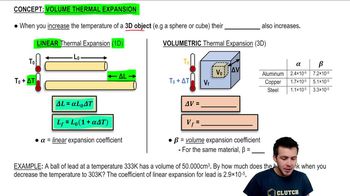
Volume Thermal Expansion
Related Practice
Textbook Question

A 215-g sample of a substance is heated to 330°C and then plunged into a 105-g aluminum calorimeter cup containing 185 g of water and a 17-g glass thermometer at 10.5°C. The final temperature is 35.0°C. What is the specific heat of the substance? (Assume no water boils away.)

1168
views
Textbook Question

The heat capacity, C, of an object is defined as the amount of heat needed to raise its temperature by 1 °C. Thus, to raise the temperature by ∆T requires heat Q given by Q = C∆T. What is the heat capacity of 38 kg of water?

1229
views
Textbook Question

If 3.40 x 10⁵ J of energy is supplied to a container of liquid oxygen at -183° C , how much oxygen can evaporate?

781
views
Textbook Question

(a) How long does it take a 750-W coffeepot to bring to a boil 0.75 L of water at sea level initially at 11°C? Assume that the part of the pot which is heated with the water is made of 250 g of aluminum, and that no water boils away.

(b) For how long could this amount of energy run a 60-W lightbulb?

1339
views
Textbook Question

A 0.095-kg aluminum sphere is dropped from the roof of a 55-m-high building. If 65% of the thermal energy produced when it hits the ground is absorbed by the sphere, what is its temperature increase?

1217
views
Textbook Question

(II) A cube of ice is taken from the freezer at -8.5°C and placed in an 85-g aluminum calorimeter filled with 310 g of water at room temperature of 20.0°C. The final situation is all water at 17.0°C. What was the mass of the ice cube?

827
views