Ch 15: Oscillations
Knight Calc - Physics for Scientists and Engineers 5th Edition
Knight Calc5th EditionPhysics for Scientists and EngineersISBN: 9780137344796Not the one you use?Change textbook
Chapter 15, Problem 13a

An air-track glider attached to a spring oscillates with a period of 1.5 s. At t = 0 s the glider is 5.00 cm left of the equilibrium position and moving to the right at 36.3 cm/s. What is the phase constant?

Verified step by step guidance
1
Step 1: Start by identifying the equation for the position of a simple harmonic oscillator: x(t) = A * cos(ωt + φ), where A is the amplitude, ω is the angular frequency, t is the time, and φ is the phase constant. The goal is to solve for φ.
Step 2: Calculate the angular frequency ω using the relationship ω = 2π / T, where T is the period of oscillation. Here, T = 1.5 s.
Step 3: Use the given information at t = 0 s to substitute into the position equation x(0) = A * cos(φ). The position x(0) is given as -5.00 cm (left of equilibrium). This provides one equation involving φ.
Step 4: Use the velocity equation v(t) = -A * ω * sin(ωt + φ) to find another relationship involving φ. At t = 0 s, the velocity v(0) is given as +36.3 cm/s (moving to the right). Substitute v(0) and ω into the equation.
Step 5: Solve the system of equations obtained from the position and velocity expressions to determine the phase constant φ. Use trigonometric identities and algebraic manipulation to isolate φ.

Verified video answer for a similar problem:

This video solution was recommended by our tutors as helpful for the problem above.
Video duration:
6m
Was this helpful?

Key Concepts

Here are the essential concepts you must grasp in order to answer the question correctly.

Simple Harmonic Motion (SHM)

Simple Harmonic Motion is a type of periodic motion where an object oscillates around an equilibrium position. The motion is characterized by a restoring force proportional to the displacement from equilibrium, leading to sinusoidal motion. In this context, the air-track glider's oscillation can be described using SHM principles, which are essential for determining the phase constant.
Recommended video:
Guided course
07:52
Simple Harmonic Motion of Pendulums

Phase Constant

The phase constant is a parameter in the equation of motion for oscillating systems that determines the initial position and direction of motion at time t=0. It is crucial for accurately describing the state of the system at any given time. In this problem, the phase constant will help relate the initial conditions of the glider's position and velocity to its oscillatory motion.
Recommended video:
Guided course
08:59
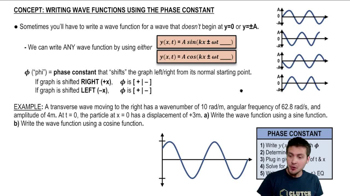
Phase Constant of a Wave Function

Equations of Motion for SHM

The equations of motion for Simple Harmonic Motion describe the position and velocity of an oscillating object as functions of time. The position can be expressed as x(t) = A cos(ωt + φ), where A is the amplitude, ω is the angular frequency, and φ is the phase constant. Understanding these equations is essential for solving the problem and finding the phase constant based on the given initial conditions.
Recommended video:
Guided course
07:18
Equations of Rotational Motion