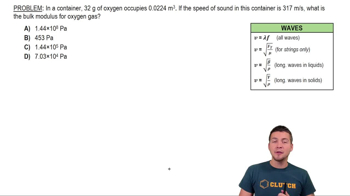
(II) How much pressure is needed to compress the volume of an iron block by 0.10%? Express your answer in N/m2, and compare it to atmospheric pressure (1.0 x 10⁵ N/m2).
Verified step by step guidance
1
Determine the relationship between pressure and volume change using the bulk modulus formula: \( B = -\frac{\Delta P}{\frac{\Delta V}{V}} \), where \( B \) is the bulk modulus, \( \Delta P \) is the change in pressure, \( \Delta V \) is the change in volume, and \( V \) is the original volume.
Rearrange the formula to solve for \( \Delta P \): \( \Delta P = -B \cdot \frac{\Delta V}{V} \).
Substitute the given values into the formula: The bulk modulus of iron is approximately \( B = 1.6 \times 10^{11} \; \text{N/m}^2 \), and the volume change is \( \frac{\Delta V}{V} = -0.10\% = -0.0010 \) (negative because the volume decreases).
Perform the substitution: \( \Delta P = -(1.6 \times 10^{11}) \cdot (-0.0010) \). Simplify the expression to find the pressure change.
Compare the calculated pressure change \( \Delta P \) to atmospheric pressure \( 1.0 \times 10^5 \; \text{N/m}^2 \) by dividing \( \Delta P \) by \( 1.0 \times 10^5 \) to express the result as a multiple of atmospheric pressure.
Verified video answer for a similar problem:
This video solution was recommended by our tutors as helpful for the problem above
Video duration:
5m
Play a video:
0 Comments
Key Concepts
Here are the essential concepts you must grasp in order to answer the question correctly.
Pressure
Pressure is defined as the force applied per unit area on a surface. It is measured in pascals (N/m²) and is a crucial concept in understanding how forces affect materials. In the context of compressing an object, pressure determines how much force is needed to change its volume.
The bulk modulus is a measure of a material's resistance to uniform compression. It quantifies how much pressure is required to achieve a certain change in volume. For solids like iron, the bulk modulus is essential for calculating the pressure needed to compress the material by a specific percentage.
Atmospheric pressure, approximately 1.0 x 10⁵ N/m², serves as a reference point for understanding other pressures. Comparing the calculated pressure needed to compress the iron block to atmospheric pressure helps contextualize the magnitude of the force required, illustrating whether it is relatively small or significant in practical terms.

 5:59 minutes
 Verified step by step guidance
 17:04
17:04