How many atoms are in a 2.0 cm×2.0 cm×2.0 cm cube of aluminum?
Verified step by step guidance
1
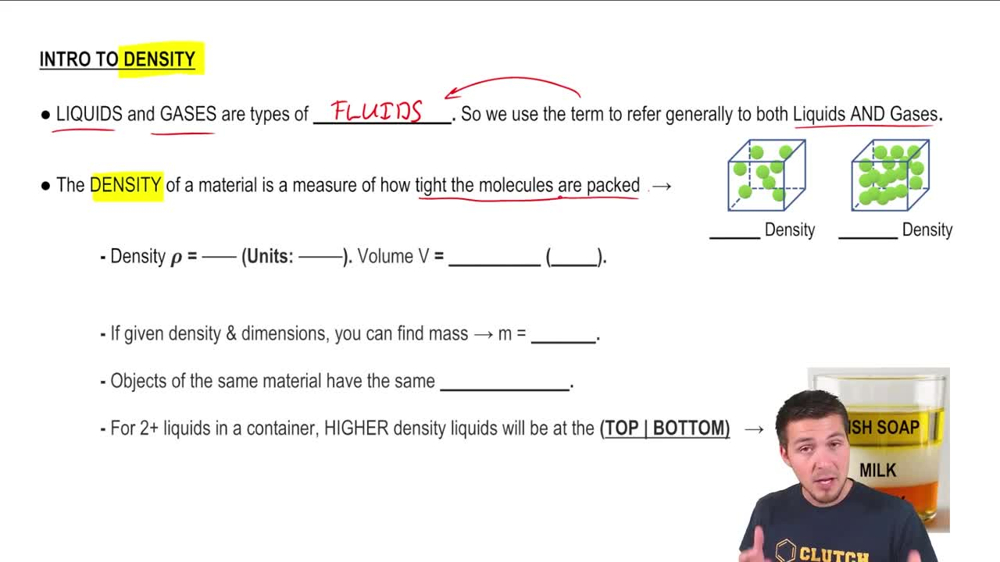
Step 1: Calculate the volume of the aluminum cube. Use the formula for the volume of a cube, which is \( V = a^3 \), where \( a \) is the length of one side of the cube. Here, \( a = 2.0 \, \text{cm} \).
Step 2: Convert the volume from cubic centimeters (\( \text{cm}^3 \)) to cubic meters (\( \text{m}^3 \)) because the density of aluminum is typically given in \( \text{kg/m}^3 \). Use the conversion factor \( 1 \, \text{cm}^3 = 10^{-6} \, \text{m}^3 \).
Step 3: Use the density of aluminum, \( \rho = 2700 \, \text{kg/m}^3 \), to calculate the mass of the aluminum cube. The formula is \( m = \rho \cdot V \), where \( \rho \) is the density and \( V \) is the volume in \( \text{m}^3 \).
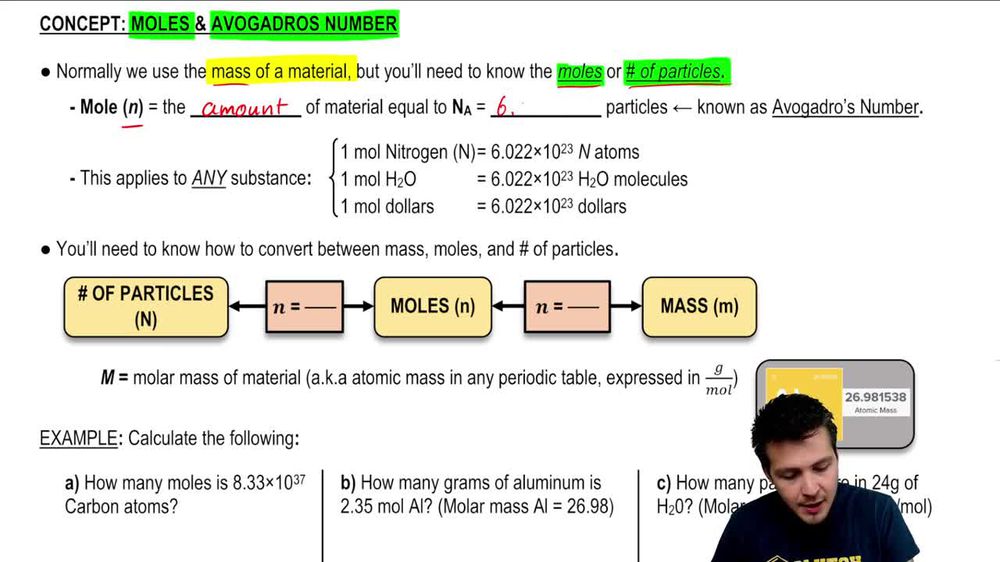
Step 4: Determine the number of moles of aluminum in the cube. Use the molar mass of aluminum, \( M = 26.98 \, \text{g/mol} \), and the formula \( n = \frac{m}{M} \), where \( m \) is the mass in grams (convert \( \text{kg} \) to \( \text{g} \) by multiplying by 1000).
Step 5: Calculate the number of atoms in the cube using Avogadro's number, \( N_A = 6.022 \times 10^{23} \, \text{atoms/mol} \). Multiply the number of moles \( n \) by \( N_A \) using the formula \( N = n \cdot N_A \).
Verified video answer for a similar problem:
This video solution was recommended by our tutors as helpful for the problem above
Video duration:
3m
Play a video:
0 Comments
Key Concepts
Here are the essential concepts you must grasp in order to answer the question correctly.
Atomic Structure
Atoms are the basic building blocks of matter, consisting of protons, neutrons, and electrons. In the context of aluminum, each atom has a specific arrangement of these subatomic particles, which determines its properties. Understanding atomic structure is essential for calculating the number of atoms in a given volume of a material.
Density is defined as mass per unit volume and is a critical property for determining how many atoms are present in a specific volume of a substance. For aluminum, the density is approximately 2.7 g/cm³. By knowing the density, one can calculate the mass of the aluminum cube and subsequently the number of atoms it contains.
Avogadro's number, approximately 6.022 x 10²³, is the number of atoms or molecules in one mole of a substance. This concept is crucial for converting the mass of aluminum into the number of atoms. By using the molar mass of aluminum (about 27 g/mol), one can determine how many moles are in the cube and then multiply by Avogadro's number to find the total number of atoms.

 3:28 minutes
 Verified step by step guidance
 01:06
01:06